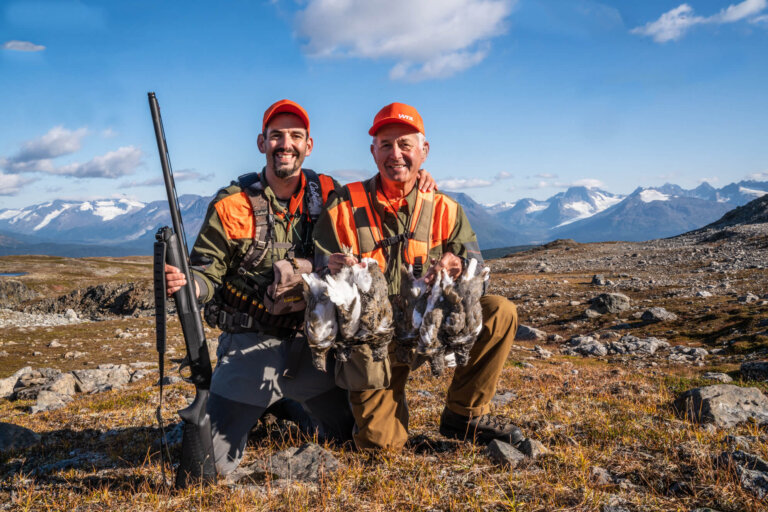
As one of the most over looked upland species, the ptarmigan is also one of the most challenging to the hunter if he seeks to take each of the different species. There are three species of ptarmigan. The Willow Ptarmigan, which as its name would suggest, are found in lower willow areas near small lakes and streams. The Rock Ptarmigan generally are found in the transition areas between where the vegetation thins out and the rocks begin on the mountain sides. The White-tailed Ptarmigan live in the rocky areas towards the tops of the mountains. When researching the different areas to hunt ptarmigan, I kept returning to the same area in Alaska because it is one of the few spots where you can hunt for all three species of ptarmigan on a single hunt. We were again headed for Alaska, one of the greatest states for hunting in the US.
In researching the area, there weren’t many outfitters or guides who advertised being able to get all three species of ptarmigan on a single trip. Most would only advertise Willows as they are the easiest to get and also have the highest density of the three different species. But, between Tony Witte at WTA and myself, we were able to find a transporter who had previous success hunting and getting his hunters into all three species. His history and information would be vital in getting us dropped off in the correct areas for success. As summer was in full swing, and the countdown to my quest for the Upland Slam was starting, I was hit with the bad news that Bob, our transporter, had ruptured his achilles tendon and wasn’t sure if he would be able to fly in time to get us out for our September hunt. Tony and I went into panic mode, but with no one else having either confidence or past success on getting into all three species of ptarmigan, our ptarmigan plan was quickly unraveling. Fortunately, a couple weeks later, Bob called me and said “I’ve been thinking. I’m a bird hunter at heart and what you are trying to do is not only great for increasing awareness of ptarmigan but it will also raise awareness for all upland hunting. I can ride co-pilot and get another pilot to fly us into the lakes where we can drop you off. Then, I can point you to the areas where we have had success in the past”. I thanked Bob for his solution and our quest for ptarmigan was back on track.
After my trip to Nevada for Himalayan Snowcock, the plan was for my Dad to fly up to Anchorage and meet me and Grant, my good friend and cameraman. Dad would be flying with his Brittany Spaniel, Tiny, and he would also have two of my Brittany’s, Arrow and Shooter. Talk about supporting me on my quest for the Upland Slam, my Dad is flying with three dogs and all of the equipment and gear needed for the next month! In Nevada, luck was with us on the snowcock hunt, and we were able to fly and meet Dad as planned. We all arrived into Anchorage near the same time and loaded up our two rental SUV’s. With three dog kennels, boots and clothes, guns and equipment for hunting and filming, there was no way we could fit everything into a single SUV. After packing our SUV’s, we set out on our 3+ hour drive down the Kenai Peninsula to our lodge that was dog friendly. Along the way, we picked up groceries and upon arrival started to unpack and take care of our dogs. The plan was that we would be going out daily by float plane to do day hunts near different lakes. As we were getting set up for the next day, Bob walked in and said that the weather for the next day wasn’t looking the best. He said the plan was to look at the weather hourly in the morning. If the storm cleared, we could get out either late morning or early afternoon.
When we woke the next morning, there was a nasty storm with rain and dense fog. This combo made for impossible flying conditions and we were not able to reach the high alpine lakes. But, as the morning progressed, the storm cleared up and the fog lifted. Bob gave the “all clear” at noon and we took off on our flight of 60 miles, in a Beaver float plane, headed to an alpine lake that sometimes held all three species of ptarmigan, depending upon what elevations were hunted. Flying in and out of the Chugach mountains was worth the trip all by itself, as the mountains are nothing short of amazing, gorgeous and brutal, all at the same time. This area looked similar to the areas I often call home while hunting sheep and mountain goats. I was initially worried about how the dogs would do on the float plane, as there wasn’t room to fit all of the kennels in. But, much like Dad and I, the dogs seemed anxious with anticipation of what the day would bring.

Dad and I, with the help of good friend and dog trainer Justin McGrail, of Black Creek Dog Training Center in West Michigan, had been working hard all summer to get our dogs ready for what was going to be an extremely busy fall and winter. All of that time, effort, and training had led to this hunt, the first of many with our dogs during this quest for the Upland Slam. Our dogs were all jacked up and full of energy, so Dad and I decided that on the first afternoon we would take all three dogs out with us so they could burn off all of their initial energy. After that, we would put them on rotation in an effort to not burn any of them out. We would need our dogs healthy and they were more important than any other piece of equipment or gear we had with us.
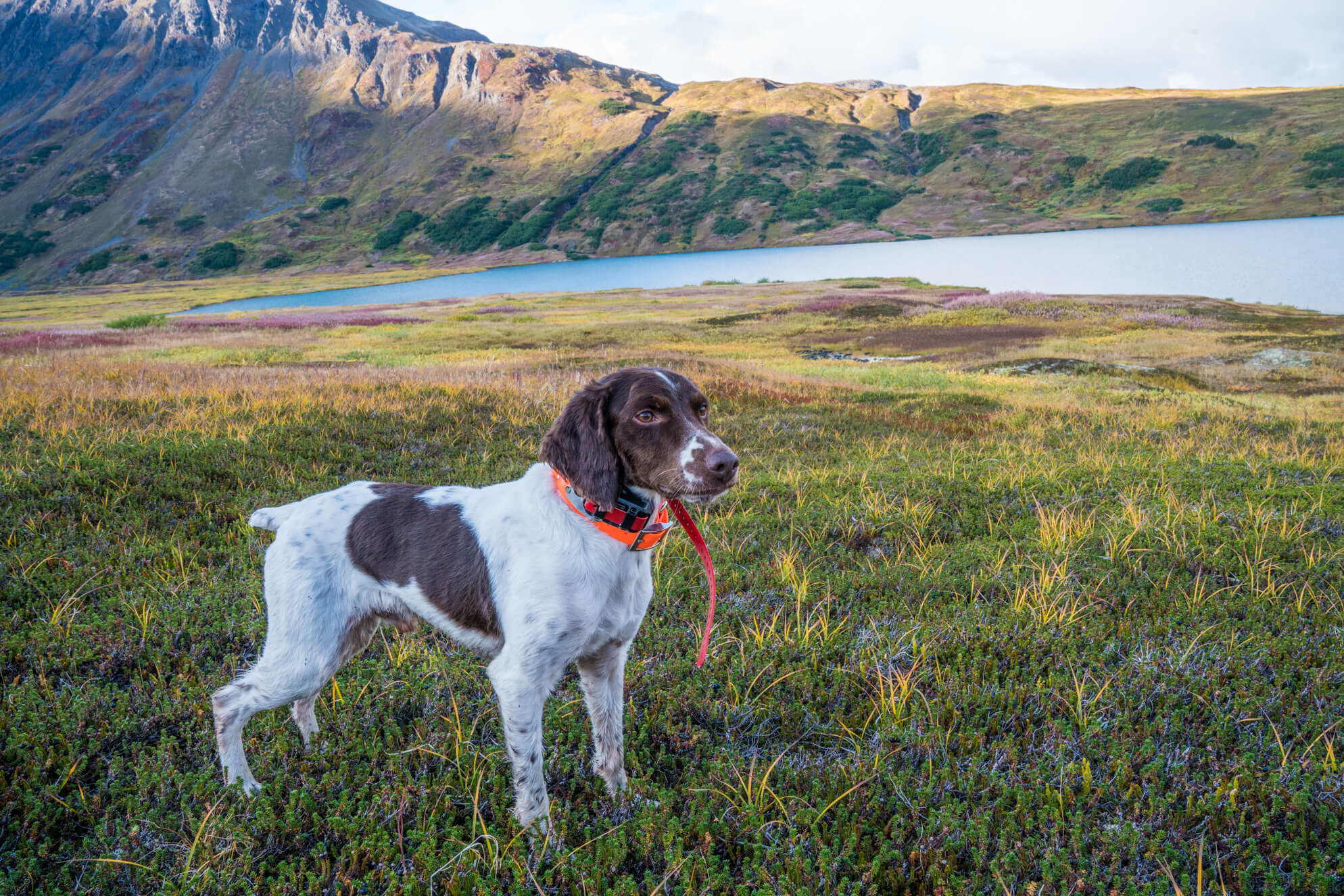
As the plane pulled up to the rock shore and tied off on the east side of this lake in the middle of nowhere Alaska, Bob stepped down in his walking boot and started to explain the area. He pointed to areas, where in past years, he had found Willows, then up at higher areas for Rocks and then, even higher towards the summits, areas that might contain White-tailed. We unloaded the dogs and they must have thought they had reached hunting heaven, as all three hit the ground running. We were ptarmigan hunting in Alaska. After listening to Bob, Dad and I came up with a plan to make a straight-line hike to the top of the mountain in search of White-tailed Ptarmigan as these would be the hardest of the three species to locate and hunt. After hiking up the mountain for a good hour, Shooter locked up on point and Arrow quickly did an honoring point. I started to approach, and as I looked in front of Shooter, I could see the alders moving and ptarmigan milling around. As I got to within 30 yards of the cover, ptarmigan exploded out. None of my three shots connected with any of the ptarmigan. It was not the start I was hoping for, but it looked like we were in the middle of ptarmigan and the dogs were doing great.
Shortly after my great shooting display, I heard Dad shoot. He was on the other side of a nearby nob, and although he was walking in line with me, he was out of sight. As we met at the next ledge on the mountain, Dad pulled out a ptarmigan from his pack. It was a beautiful Rock Ptarmigan. As we were hunting in the middle of September, the ptarmigan had started to change from their summer colors to their winter white feathers. After a quick break, we continued our climb up the mountain, and were soon in an area that had no vegetation and just rocks. This looked more like mountain goat country than ptarmigan country. We started to work the dogs again, but after an hour I came over to Dad and said I must have heard Bob wrong. There is no way ptarmigan live up this high. We started our way back down the mountain and decided on the way down we would hunt some willow and alder patches.
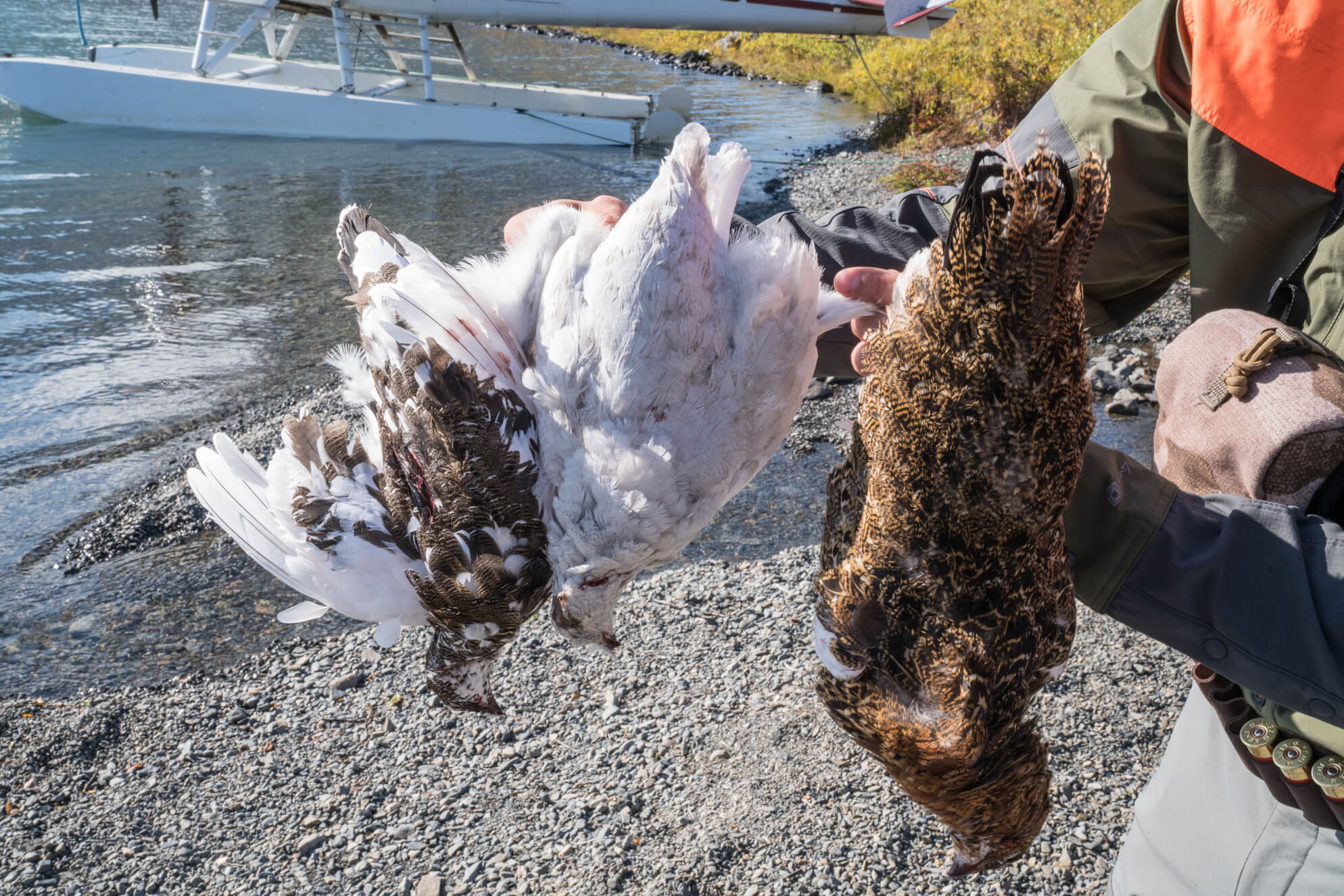
On the first alder patch all three dogs locked up on point. I approached and birds started to explode out everywhere. This time I was able to make my first shot count and I had my first ptarmigan species, a Willow Ptarmigan. As we continued down the mountain, the dogs locked up on point at almost every wooded patch we approached. Soon a group of Willows would bust out and our shots followed. By the time we arrived back at the plane, I had my limit of Willow Ptarmigan, which is 10 birds in the area we were hunting. Dad had his Rock and also a bunch of Willows himself. It was a great afternoon ptarmigan hunt.
Back at the lodge that night, Bob stopped by to see how we had done. We explained where we had stopped on the mountain by showing him the route we walked as mapped on our Garmin GPS’s. He told us we weren’t high enough to get into the White-tailed Ptarmigan. I was blown away, as I thought we were too high, but these birds live up there with the mountain goats and sheep. We discussed our plan for the next day, and looking at the weather forecast, we should have good flying. Versus trying a different lake or area, we would head back to the same lake with the idea of hunting the west side in the morning and going up high for White-tailed. If we didn’t run into any, we would go back to the east side and go up higher than we had the previous day.
The next morning arrived with nothing but sun and an uneventful float plane ride back to the lake. Looking up at how high we would be going, Dad decided that he would stay back with Arrow and Tiny. Not wanting to burn himself out, he would hunt the afternoon on what was going to be more of a sheep hunt than an upland hunt.
I took off with Grant and Shooter and we started our walk to the top. I kept Shooter on a leash as I didn’t want to burn him out before getting to the top. After about 2 ½ hours of climbing, we reached the first ledge. On this trip I brought my binos so I could better plot a course up the mountain prior to walking. I’m a firm believer in “hunting smarter versus harder”. Stopping to glass, I spotted several ptarmigan higher up and skylined on a rock outcropping. We started to climb in that direction, and as we got closer, I let Shooter off of his leash. We walked up the backside, with the wind blowing in our face, and upon reaching the top Shooter locked up like a statue. He held rock solid as Grant and I got into position as quick as possible. In front of Shooter was a lone ptarmigan on a rock, and he was much closer than the larger group. It was decision time. Should I try for this lone bird, which I knew wasn’t a Willow as we were up too high, but because the sun was directly in my eyes, I couldn’t tell if it was a Rock or a White-tailed. I looked at shooter who was rock solid, with his eyes locked in on the bird, and my decision was made. This was too perfect of a situation to pass on. I walked up, the bird took off, and I followed with a good shot. The bird was down and when Shooter brought it back to me, I found I had my first Rock Ptarmigan. Dad and I both had 2 of the 3 species.
I have to admit, with all of the research I did before our trip, it was still tough for me to tell the difference between the three different species of ptarmigan. But after being able to see a specimen of each, I’m much more knowledgeable and now able to easily tell them apart. The White-tailed are the easiest to distinguish because, as their name would suggest, their tail-feathers are all white. Both the Rock and Willow Ptarmigan have black on their tail-feathers. The White-tailed is also noticeably smaller than the Rock or the Willow. The Willow is the largest of the ptarmigan and they have black on their tail-feathers but their body feathers are brown. The Rock also have a black band on their tail-feathers but their body feathers are gray.
After putting my Rock Ptarmigan in my pack, I put Shooter back on the leash. As we had taken a Rock Ptarmigan here, we needed to climb higher to reach the White-tailed. We continued up another hour, into a bowl area that literally had sheep beds in it. It felt all wrong, but I trusted Bob who told me that when you hit the area that looks like the surface of the moon, you’re in the right spot. I was trying to figure out how to hunt this extreme terrain or if I could even let Shooter off the leash. The rocks had extremely sharp edges and the ledges had steep drop offs. I love my dogs too much to risk injury, or something worse, during a hunt. As I was standing there thinking, I felt a slight pull on the leash, looked down and Shooter was on another point. Yes, he was on point while on the leash. I looked forward and, with the wind blowing in my face, I saw little birds moving around the rocks. They were very well camouflaged and about 80 yards ahead of us. I am not positive, but I think I found the elusive White-tailed Ptarmigan. I slipped the leash off of Shooter, and gave him the command to move forward. He slowly crept up 30 yards and locked up again.
As I slid up alongside of him, I saw that there must be at least 50 ptarmigan moving in the rocks. I moved up and two birds exploded from the rocks. I swung quickly to make it a double. As Shooter was bringing them back to me, I noticed that their tails were all white; I realized that I had my ptarmigan slam in hand. There were just too many birds up there not to chase them around for a bit and I ended up with seven before it hit me that I needed to go back down the mountain and get my Dad to come up here for his White-tailed.
I put Shooter back on the leash and we started to move back down the mountain. As we hit the grassy area, I let him off the leash to start working the last mile down. It didn’t take long for him to lock up on a lone pine tree in knee high grass. I had a total of 8 ptarmigan in my bag and they are Rock and White-tailed Ptarmigan. I walk up on Shooter and he has a group of Willow Ptarmigan pinned in front of him. A quick double, I have my daily bag limit and I also just completed the ptarmigan slam in a single day. Without a doubt this would be a day I will always remember, not because of the limit, not because of the slam, but because Shooter pointed and retrieved all three species in a single day. As an upland hunter, I couldn’t have been prouder of Shooter.
One of the main reasons I had walked Shooter on a leash was the sharp edges on the rocks. Sharp edges and paws don’t go together. As a high energy dog, I wanted him walking and not running. Back at the plane I checked his feet, and my heart sank as I saw cuts on three of his pads. Shooter was going to need some time off before he would again be 100%. For those of you looking to bring your own dogs up to ptarmigan hunt, please keep this in mind. I had been tempted to put boots on him, but I wanted him to have all of his foot webbing so he would not slip or fall on the rocks. That didn’t work. For White-tailed, either use boots or seriously consider not bringing your dog across the rock fields.
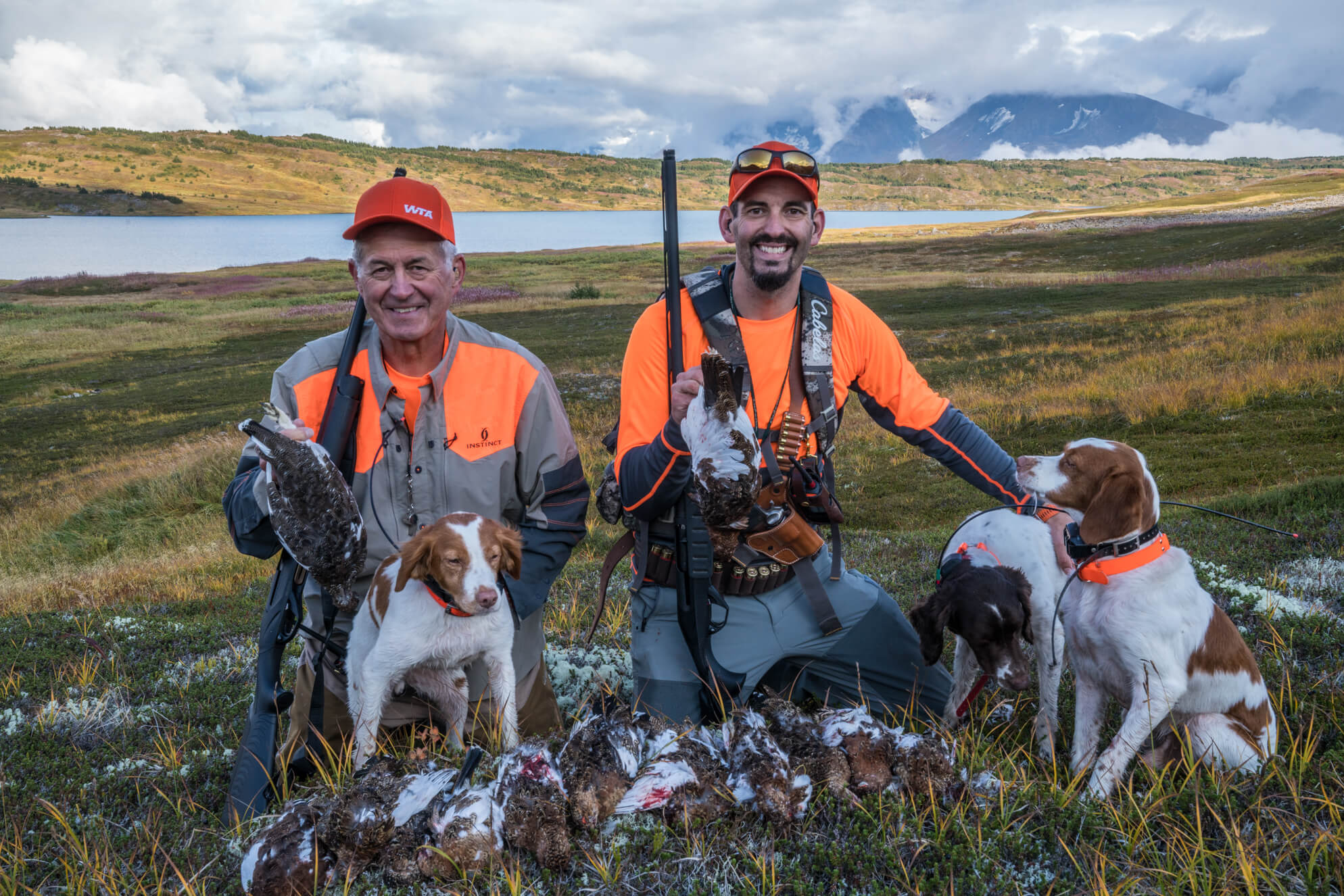
After taking care of Shooter and regrouping, I asked Dad “Are you ready for a hike?” But this time, we were going without any of the dogs. They weren’t needed as I had a pretty good idea where the majority of the White-tailed Ptarmigan went. We took our time as we slowly moved up and covered the 2,000+ foot elevation change to get back into the bowl where we had earlier found the large group of White-tailed Ptarmigan. As Dad and I walked up the mountain, I was hoping that this would be another great ending of a hunt that we would add to our constantly growing list. Dad is almost 72 years old, but you would not know it watching him hiking across a field or climbing up a mountain. We topped into the bowl and I started glassing with my binos. Hunting plans don’t always work this way, but the group was pretty darn close to where I thought they would be. Dad slowly worked his way over the rocks and walked up to a group of White-tailed. They rose and he completed his ptarmigan slam. As we worked our way back down the mountain to the plane, Dad and I talked about just how great Alaskan ptarmigan hunting was. Hunting with family and good bird dogs; it can’t get much better than that.