Book Your Adventure 1-800-346-8747

Dugga Boys of the Niassa

Travis Baker
|  
Location: Mozambique

There’s nothing quite like Africa. Like sheep hunting, it gets in your blood. Go once and you’ll want to go back…again and again.

I began planning this safari nearly two years ago when I met with one of our top African outfitters at an outdoor show. I told him I wanted to hunt an old buffalo and had clients that would join me. He didn’t hesitate. “You need to hunt the Niassa Game Reserve.” Located in northern Mozambique, Niassa is one of Africa’s largest, wildest, and most protected areas. It includes over 10 million acres of some of the most remote landscape on the continent. It’s connected to the Selous Game Reserve in southern Tanzania, making this one of Africa’s largest contiguous wilderness areas. Not a fence for two thousand miles. Niassa is separated into multiple hunting blocks where outfitters have exclusive hunting rights. This particular outfitter holds two side-by-side concessions, totalling over 1.5 million acres. You won’t even see a fraction of it during a 10-day safari. It’s that big. The landscape consists of miombo woodlands, riverine forest, bamboo thickets, open savannah, and granite mountains. Some of the prettiest country I’ve ever seen. Animals are on quota and managed accordingly. It is home to 4 of the Big 5, plus huge crocodiles along the river systems, hippos, and countless plainsgame including numerous endemic species like the Roosevelt sable, Johnston’s impala, Bohms zebra, Livingstone eland, and Niassa wildebeest.
Mozambique offers a classic, Hemingway-style safari rich in tradition, where animals roam completely free. Hunters need to be prepared to do some hiking to harvest an animal. Northern Mozambique, specifically the Niassa Game Reserve, offers some of the finest wild cape buffalo hunting anywhere along with an incredible population of leopard and lion.

Fast forward to August 29, 2023. I boarded a flight to Atlanta, where I met up with four of my WTA customers. This would be my third safari to Africa, but my first dangerous game hunt. For the rest of my group, it was their first safari to the Dark Continent. We were booked for a 10-day cape buffalo and plainsgame hunt. I booked the first 10 days of September during the drier season. This tends to be the best time to hunt buffalo here. We boarded the long flight across the pond, landing in Johannesburg nearly 24 hours later (taking into account the time change). I had arranged for us to be met by a transfer company as soon as we walked off the jetway. They would assist with our firearms as well. Money well spent! The benefit of joining a WTA-hosted trip is traveling as a group. If you were ever hesitant on pulling the trigger on a trip like this, give us a call. There’s a definite comfort factor to knowing you’re traveling with an experienced group host who will have all of the logistics handled ahead of time: air travel, firearms paperwork, airport meet and greet services, overnights, etc. We take care of the details so you don’t have to. After whisking us through customs and handling our luggage and firearms, we were soon at our hotel for a delicious meal and some much-needed sleep.
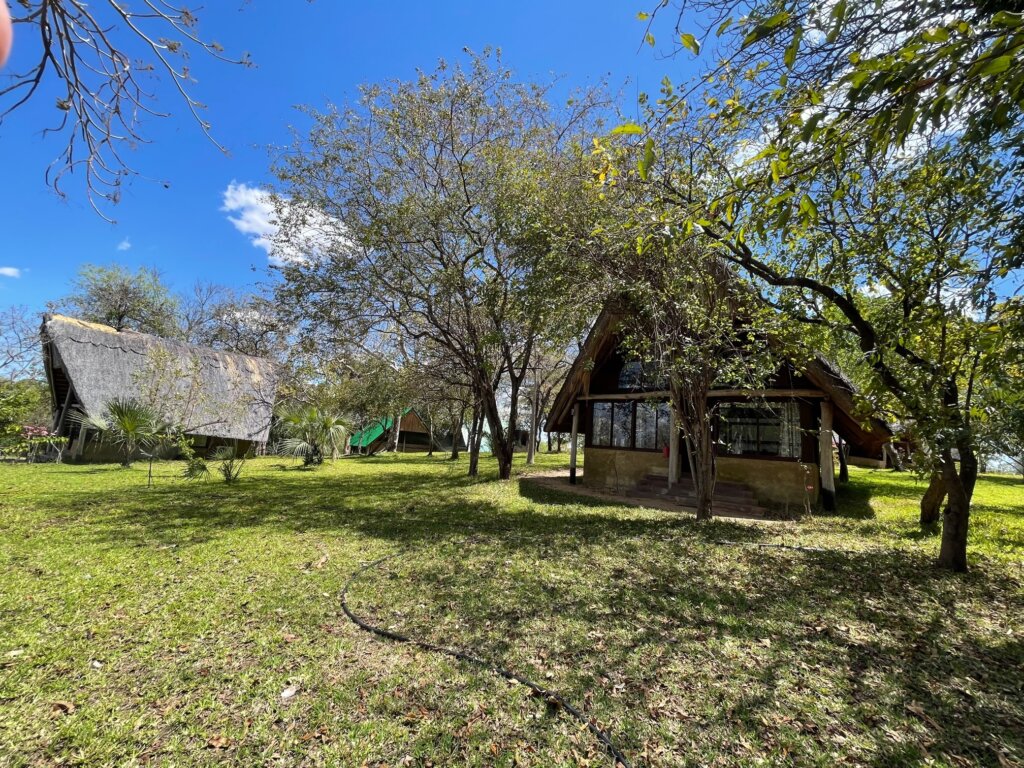
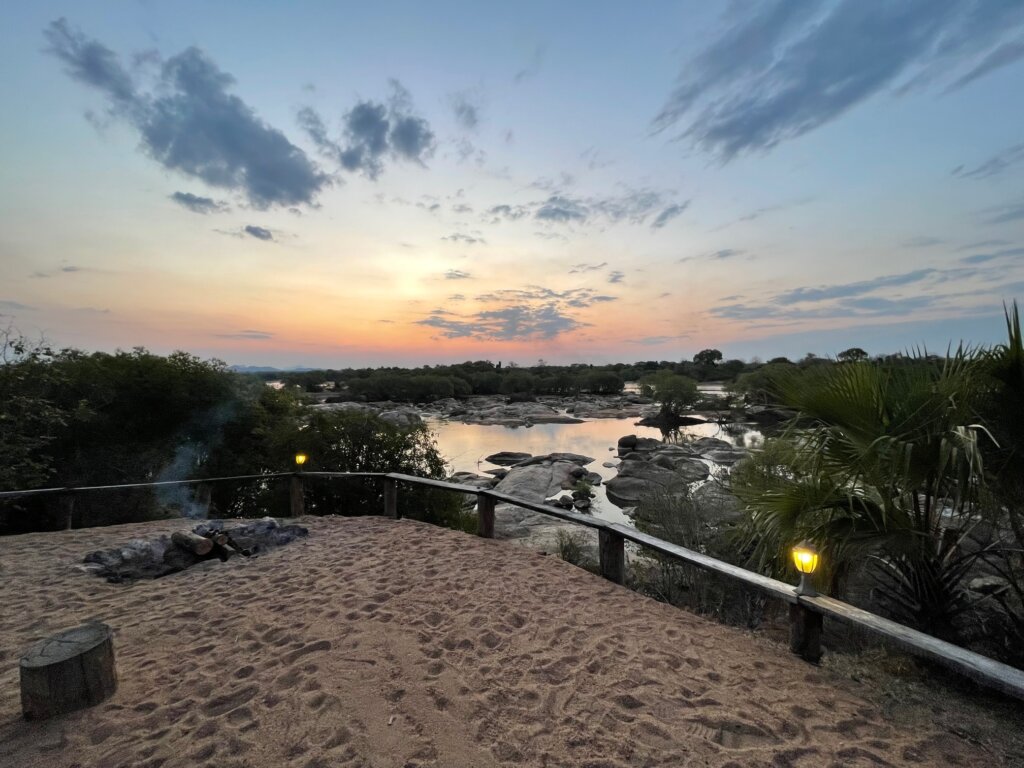
The following morning we were transferred back to the airport for a 2 ½ hour flight to Pemba, located along the Indian Ocean in northern Mozambique. From here, we would board a Cessna caravan for the one-hour flight into the Niassa Game Reserve, where we would land on a dirt air strip right next to our hunting camp. We were met by the staff, checked our rifles, and got settled into our accommodations for the next two weeks. It was amazing what they had in the middle of the African bush. Each of us had our own air-conditioned chalet with private bath, plus an open-air main lodge with infinity pool, dining area, bar, and wifi. The property was set high on the river-bank overlooking the Lugenda River with incredible views. We packed pretty light for this African safari since daily laundry was provided free of charge. Daily attire for this safari consisted of a lightweight pair of hiking boots or shoes, well broken-in of course, plus a few safari shirts, lightweight pants or shorts with gaiters, ammo belt or pouch, 8x or 10x binoculars, hat, sunglasses, sunscreen, and bug spray (no deet). A minimum .375 caliber is mandatory for the cape buffalo while a .270–.300 caliber is fine for the plainsgame. I was hunting with the Gunwerks Skuhl rifle on this particular trip. 

We met our PHs (professional hunters) and we were given an orientation on what to expect over the next 10 days. Long days and short nights. We were up at 4 a.m. each morning for a light breakfast and coffee before heading out before daybreak. Like I mentioned before, this area is huge so you may need to travel well over an hour to your hunting area. Each hunter had their own PH, trackers, and safari vehicle. I would spend a couple of days at a time with each client, hunting together and getting to know them. No better way to do that than on a hunt! Our daily routine would consist of looking for tracks along the many roads that cut their way though the concession, or hiking in to check a waterhole midday. Here, you don’t hunt the buffalo herds, only dugga boys, solitary bulls or groups of old bulls that have left the large herds. This management tool has been in place for many years and the results speak for themselves. The buffalo hunting has never been better in this area! Once fresh tracks are cut, the trackers begin putting the pieces together and the stalk is on! You could be on tracks for several hours and must  be prepared for this. Mozambique is close to the equator and the days are very hot this time of year. One tracker would carry a pack full of bottled water. You need to stay hydrated. Mornings were usually spent looking for buffalo and then pursuing the many plainsgame during midday. Lunch was typically taken under a shaded acacia tree with cots set up for a siesta. Then, back on the dugga boy tracks later in the day. The Niassa is full of game, but you need to be prepared to walk and earn your trophy. If a stalk doesn’t work out, you’ll most likely cut more tracks down the road. But, when an opportunity presents itself, you take it.
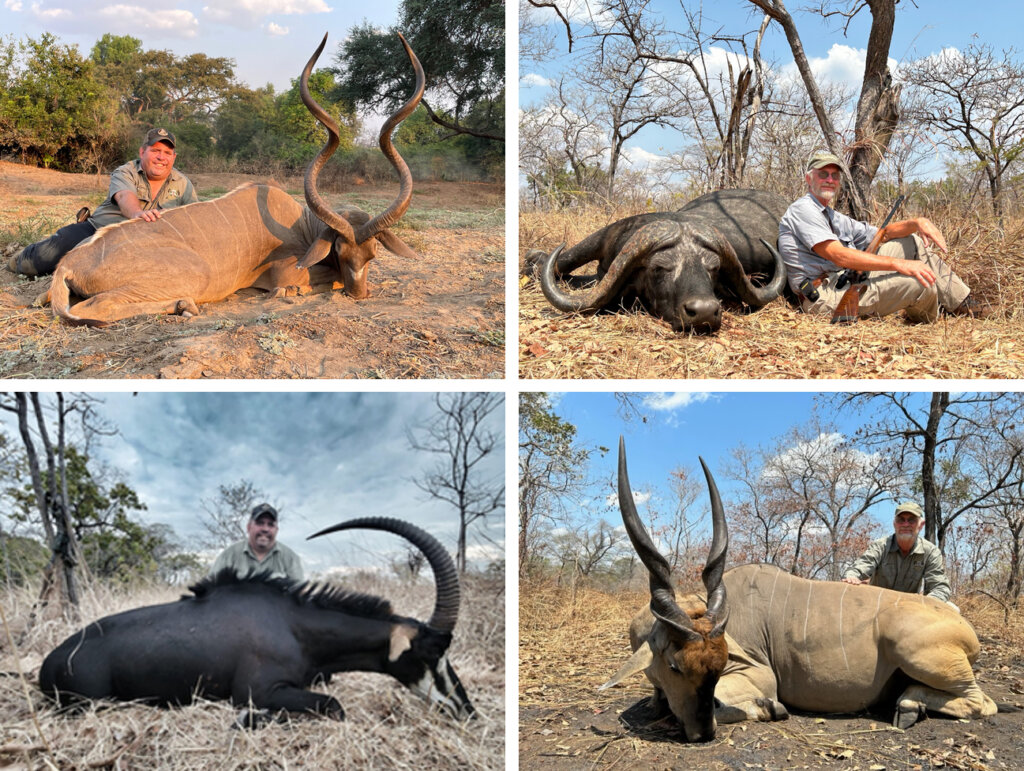
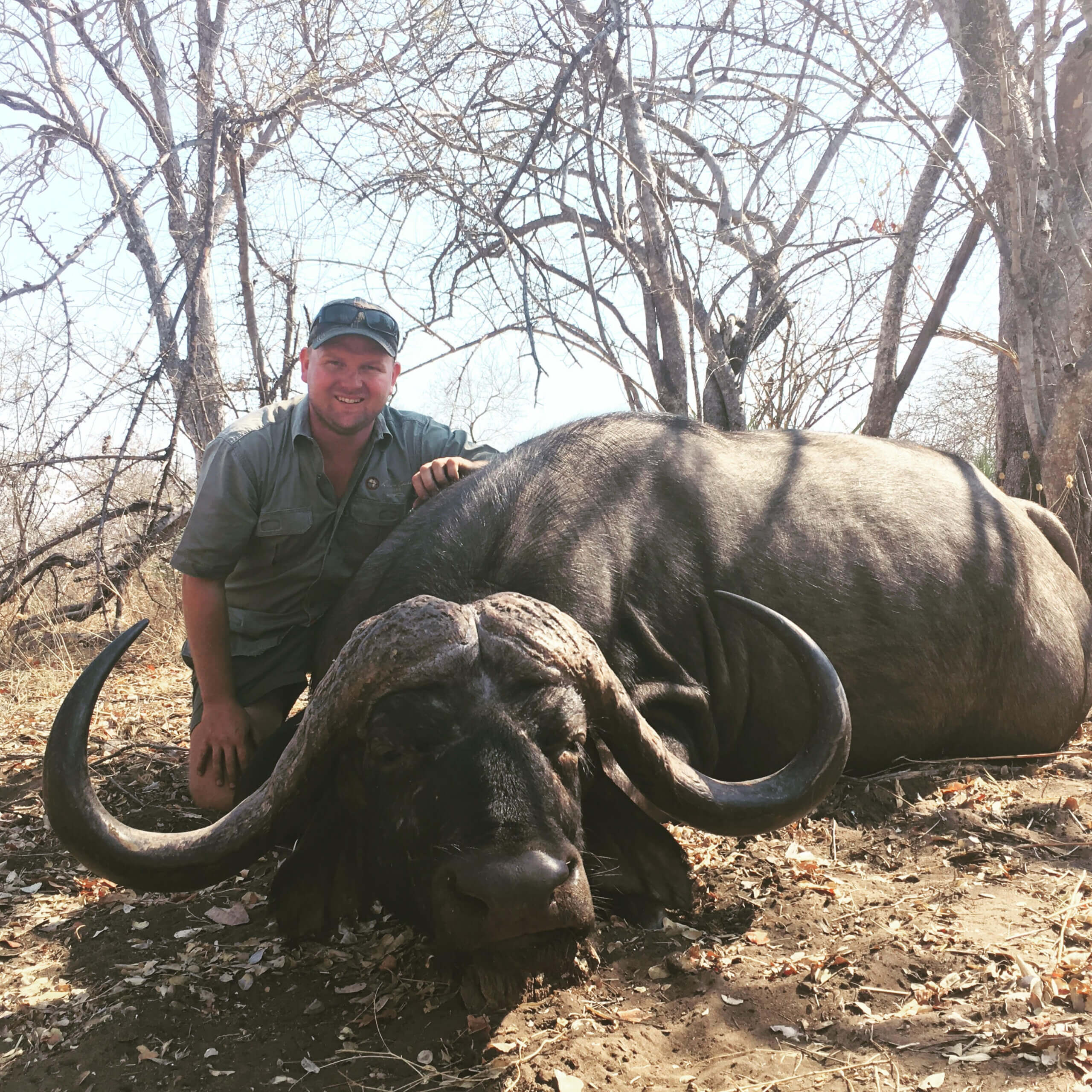
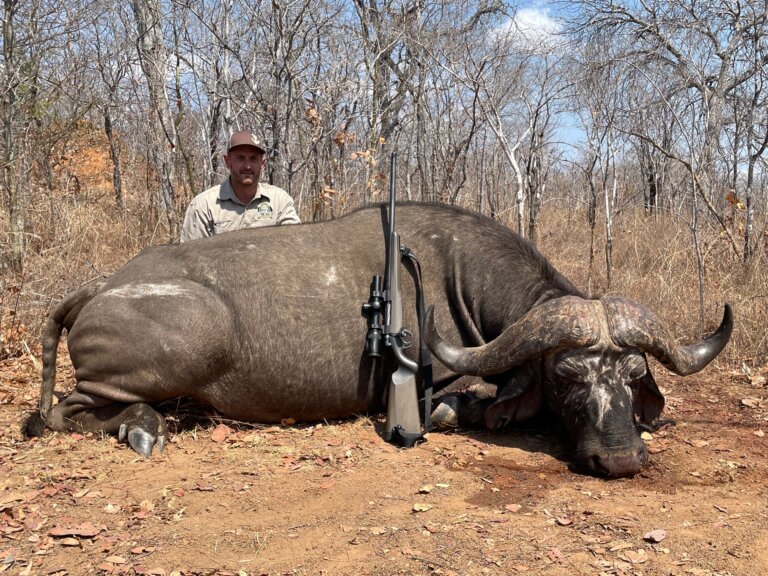
By day three we already had four buffalo down and several plainsgame including eland, sable, kudu, zebra, bushbuck, impala, wart hog, bushpig, and various duiker. Now it was my turn to hunt a dugga boy! The PH for my hunt was Darren, an old friend who I met many years ago, and who has guided our hunters for several years now. We cut a solitary track shortly after daybreak on day four. A track of an old bull. A proper dugga boy, as Darren called it. We tracked him for nearly two hours. Saw where he would feed and bedded down a couple of times. Darren’s trackers were incredible. They are the highlight of any safari. They’ve been with him for nearly 20 years. Hunting all over Africa. We finally caught up with the lone bull as he fed in a small clearing just 50 yards away. Darren set up the sticks and I settled my Gunwerks .375 Ruger. I can still visualize his heavy bosses as I looked through the scope at him feeding and settled the crosshairs on his shoulder. The first shot broke his right shoulder, and not knowing where we were, the buffalo began running our way. I settled back on the sticks for a back-up shot, and as he veered off, I hit him two more times and put him down for good. The death bellow signaled he was expiring. My adrenalin was through the roof as I approached this old bull. 1,800 pounds of sheer muscle. Heavy bosses and worn tips, scarred up face. The entire experience was everything I had imagined when I dreamt of buffalo hunting. I looked back at our trackers who were calm as could be, just another day at the office for them. You could see their sense of accomplishment on having done their job. I was just the lucky one behind the trigger.

There’s nothing quite like Africa. If you’d like to experience a trip like this for yourself, you know who to call! Reach out to us at 1-800-346-8747.
Recent Articles

Popular Hunts

Cape Buffalo, Plains Game   ·
Mozambique
From 
$10,000
Outfitter #1050
Hosted Trip
WTA Exclusive
Cape Buffalo, Plains Game   ·
Mozambique
From 
$12,000
Outfitter #1050
2nd Group: September 1-10, 2026 2-spots available ...1st Group: Aug 21-30, 2026 (SOLD OUT)

Top Mozambique Hunting Trips

Cape Buffalo, Plains Game   ·
Mozambique
From 
$10,000
Outfitter #1050
Hosted Trip
WTA Exclusive
Cape Buffalo, Plains Game   ·
Mozambique
From 
$12,000
Outfitter #1050
2nd Group: September 1-10, 2026 2-spots available ...1st Group: Aug 21-30, 2026 (SOLD OUT)

Related Articles

Wyoming’s Preference Point Deadline Is Approaching: October 31

Wyoming’s Preference Point Deadline Is Approaching: October 31

Preference Point Deadline: October 31, 2025

The deadline to purchase Wyoming preference points is October 31. If WTA is already managing your TAGS applications, you’re all set. If not, don’t miss the chance to secure points this year. It’s the perfect time to talk with a TAGS consultant to start a new portfolio or grow your existing one.

Wyoming’s system is unique. Unlike other states, you don’t automatically receive a preference point if you’re unsuccessful in the draw. Instead, you must log in after July 1 and purchase your points separately. Building points is critical if you want a shot at drawing a Wyoming tag. Over-the-counter opportunities are a thing of the past. Today, only 25% of non-resident tags are issued randomly. The other 75% go to applicants with the highest point totals.

If you want to hunt big game in Wyoming, building preference points isn’t optional…it’s essential.

Watch Wyoming Video

While preference points are an investment in the future, don’t let that keep you from starting now. While Wyoming has units that require 18+ points, there are also good opportunities to hunt sooner. There are elk, deer, and antelope hunts that can be drawn with 0–3 points. Think about it this way—the more points you have, the more options you have.

View Wyoming TAGS Hunts

Serious hunters know that Montana is home to some of North America’s most coveted species: Rocky Mountain elk, mule deer, bighorn sheep, Shiras moose, mountain goat, and antelope. The key to unlocking these dream hunts is building points, and the deadline to secure your bonus point for this year is September 30.

Montana squares bonus points in its draw system, and hunters with more points gain a significant advantage in the draw. If you’ve ever dreamed of chasing a record bull, a giant ram, or a heavy-horned buck in Montana, strategically building points will put you in the best position to find success in upcoming seasons.

Watch Montana Video Rocky Mountain Elk

Montana consistently produces exceptional trophy bulls, making elk the most sought-after species in the state. Archery permits are especially appealing, often requiring only 4–7 years to draw—a remarkably short time period compared to other western states. Rifle permits can often be drawn with a similar point investment, though trophy quality is slightly lower on average. Many of these hunts take place on expansive private ranches, providing hunters with excellent opportunities and high success rates.

View All…
Dialed In: A 360-Inch Bull Elk and the Luck that Made It Happen

Dialed In: A 360-Inch Bull Elk and the Luck that Made It Happen

Winning one hunt sweepstakes through Worldwide Trophy Adventures feels like a long shot, but winning two? That’s the kind of luck I still can’t fully wrap my head around. I started entering WTA sweepstakes a few years ago, taking full advantage of their Bonus Bucks program and hoping to win someday. I’ve hunted whitetails in Minnesota’s flat woods, mule deer out West, and Sitka blacktails in Alaska’s rugged country, but this was different. When Worldwide Trophy Adventures called to tell me I’d won their 2024 Nevada bull elk hunt, just a year after winning a Utah mule deer hunt from them, I was stunned. Two sweepstakes wins in two years? Unreal. And the icing on the cake? I’d be hunting with a crew that truly knows their elk. As Erik Schell put it: “John, when it comes to elk, these guys are paid killers.” He wasn’t wrong.

I opted to drive from Minnesota to keep costs down and bring back as much meat as possible. I loaded my truck with Yeti coolers and hit the road for the long drive, stopping in Denver for a steak dinner with a hunting buddy before tackling the last 10 hours to Baker, Nevada. That stretch through Loveland Pass was sketchy with snow and ice, and on the way back I detoured through Gillette, Wyoming to avoid a 30″ Denver snow dump. Long haul, but worth it to have my truck for the meat.

Baker is a speck of a town, population 16, just shy of the Utah line. The outfitter set us up in an Airbnb called The Corner Place. It was homey, with enough beds for me, another hunter, and the guide crew. The kitchen had stacks of premade meals like casseroles and snacks, whipped up by the outfitter’s wife. We heated them up after long days, but if we got back late, we’d hit the Border Crossing, a bar and greasy spoon split between Nevada and Utah. One side had slot machines, the other a gas station. We’d grab burgers and a bucket of Budweiser, the guide Richie’s favorite, and swap stories. It was simple, but it hit the spot.

The outfitter’s team was world-class. They’d been scouting for a week, pinpointing a bachelor group of bulls in a canyon 20 miles north. That first night, we sat around the Airbnb’s kitchen table sipping beers and scrolling through their scouting videos. Three bulls stood out: a beat-up 6×6 they called Bondo, a heavy 5×5, and a narrower 7×7. We decided to hit the canyon at dawn.

Day one was no joke. Richie, my guide, led me up the mountain before light, climbing a couple thousand feet. The air was a bit thinner than in Minnesota, but Richie kept a steady pace. Two spotters, Cameron and Ryan, worked the opposite canyon rim. It felt like I had the dream team for this once-in-a-lifetime elk hunt. We eased onto a rock ledge about 400 yards above a bench where five bulls were feeding: Bondo, the 5×5, a thin 6×6, a young 5×5, and a spike. No 7×7. This was the first time I was faced with taking a bull elk, but Richie talked me through it. “The 5×5’s got 30 inches of mass per side, swords in the 20s, probably 9 or 10 years old. Scores at least 330. Solid first bull.”

I went prone on the ledge, dialing my Gunwerks Nexus in 7 PRC to 387 yards. Richie double-checked: “386 yards.” Right as I lined up, the bull bedded down. Great. I’d waited out a mule deer for five hours once, so I knew the drill. Lying on snow with a 20° northwest wind kicking up, I started shivering after an hour. Richie saw it. “You good? We can back off, build a fire, or shoot him bedded. There’s a branch over some of his vitals. Can you slip a round under it?”

I’d put in time at Gunwerks’ Long-Range University: a hands-on, no-BS school that focuses on real-world shooting conditions, not just benchrest skills. They train you to read wind, manage stress, and make clean, ethical shots in exactly the situations that hunters face in the field. I knew my rifle, my dope, and my limits. “I got it,” I said. I checked the yardage, my level, controlled my breathing, and squeezed. The bull collapsed. “You smoked him!” Richie said. When he tried to get up, a second round finished it.

Reaching the bull was an experience I won’t forget. I’ve taken plenty of deer over the years, but this 360″ elk was in a league of its own—sheer mass, thick beams, and antlers that looked heavy even from a distance. Standing over him, the scale of the hunt hit me. We built a small fire, took photos, and soaked in the moment. Then came the hard part. The canyon was steep and treacherous, slick with snow and loose shale. I took a spill on the descent, and every step down was a test of footing and balance with meat on our backs. It took over three hours to reach the canyon floor and get the bull out, but it was worth every bit of effort. Back at camp, we celebrated the way hunters do—cold beers and a good story to tell.

We caped the bull that night and packed the meat in coolers, though it was cold enough outside to keep everything fresh. I hung around a few days, spotting for the other hunter’s bull, glassing canyons, and enjoying the Nevada backcountry. No pressure, just good times behind the glass. When I left, I strapped the antlers to my truck, crammed the coolers in, and drove 24 hours straight home, still buzzing. Back in Minnesota, I vacuum-sealed the meat, enough for months of meals, and dropped the rack with a taxidermist for a shoulder mount.

This hunt was as good as it gets. The outfitter knew every inch of that country, had bulls dialed in, and gave me options. For a guy who’s now won two WTA sweepstakes, I’ll tell you straight: these hunts are real and the sweepstakes are worth it. Nevada’s elk country and that crew of “paid killers” gave me a bull and a story I’ll be telling for years.

Don’t miss your chance to enter to win this world-class elk hunt in Nevada. The entries are limited…only 1,750 total entries, giving you very good odds of winning this elk valued at $72,000!

Enter the Nevada Elk Sweepstakes

Get Trip Specials & Cancellations,
Right Where You Want It.

No spam. Just the good stuff. Opt-out anytime.