I have upland bird hunted most of my life. Still fresh in my memory are the numerous trips with my Dad where we would go and hunt the relatively untouched aspen cuts in northern Michigan and in Michigan’s Upper Peninsula. We would load up our pickup truck, staying in cabins that were built during the first half of the 1900’s and spend many long weekends with our dogs chasing Ruffed Grouse and Woodcock. It was on these trips that my love for bird dogs and upland hunting was born and cemented. In my youth, these trips were a regular fall occurrence. After our hunt days, we would spend a lot of time at night reading articles, and books, written by bird hunters from the past. What we read in those articles directed us to locations that we would eventually hunt, or we would put them on our “go to” list for hunting. The top two locations on our “go to” list were Maine and Saskatchewan. Both of these areas had miles and miles of habitat that was perfect for grouse to thrive.
In the early 2000’s, Dad and I had the pleasure of loading up our dogs and heading to northern Maine to hunt for grouse. We had a great time there walking in the footsteps of Burt Spiller. In the vast timber regions of northern Maine, we could walk for miles and miles and never see a building or another hunter.
In planning for the upland slam this year, when it came to grouse, we decided on a trip to Saskatchewan as it was a new location where we had never hunted upland before. Saskatchewan also has the highest estimated grouse population in the world. Dad and I have hunted Saskatchewan a great deal over the last couple of years as it holds some of the best Black Bear and Whitetail hunting opportunities in North America. While we have always talked about the habitat being perfect for grouse, and we have seen numerous grouse while traveling to and from our blinds or tree stands, we had yet to bring our dogs with us. That was about to change.
The ideal habitat for grouse to thrive in is new growth forest. With the thousands of square miles in northern Saskatchewan of forest, timber management and the constant harvest of large plots, there is new and ideal grouse habitat continually being created. A major reason I love going to Saskatchewan, other than the phenomenal hunting opportunities, is the team at Safari River. To Emily and Lance and the entire staff, you are more than a client. You are part of their family.
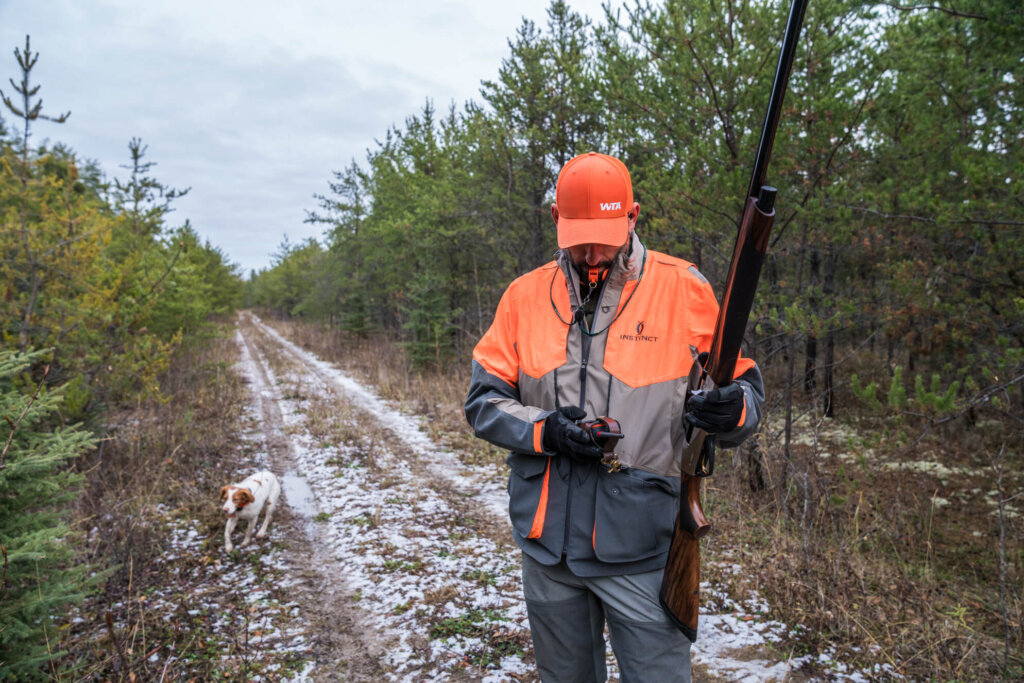
With our schedule this year being so heavy with upland hunting the western states and attempting to catch as many season openers as we could for Prairie Chickens, Sage Grouse, Sharptail, Blue Grouse, Mountain Quail, etc., we set our trip dates to Saskatchewan for late October. This was a bit later than we would have liked, but it actually worked out well as the majority of the leaves were down, which allowed for some better shooting opportunities in the thick cover. However, late in year naturally means a bit of bad weather and lower temperatures. Our first day out hunting was not ideal for traditional upland hunting at all, as it was a mix of rain and ice. Knowing this, we actually set out with the plan of trying to get one of the miscellaneous birds on my slam list, that being a snipe. Saskatchewan holds one of the largest snipe populations during the summer and fall. But, being a migratory bird, they start to head south as the weather turns cold. Knowing that we might miss them, we kept our fingers crossed that there would still be a few birds left after various cold fronts went through the area. Snipe are one of the species that we did not specifically plan a trip around, but rather had it as an opportunist bird at a couple of our locations.
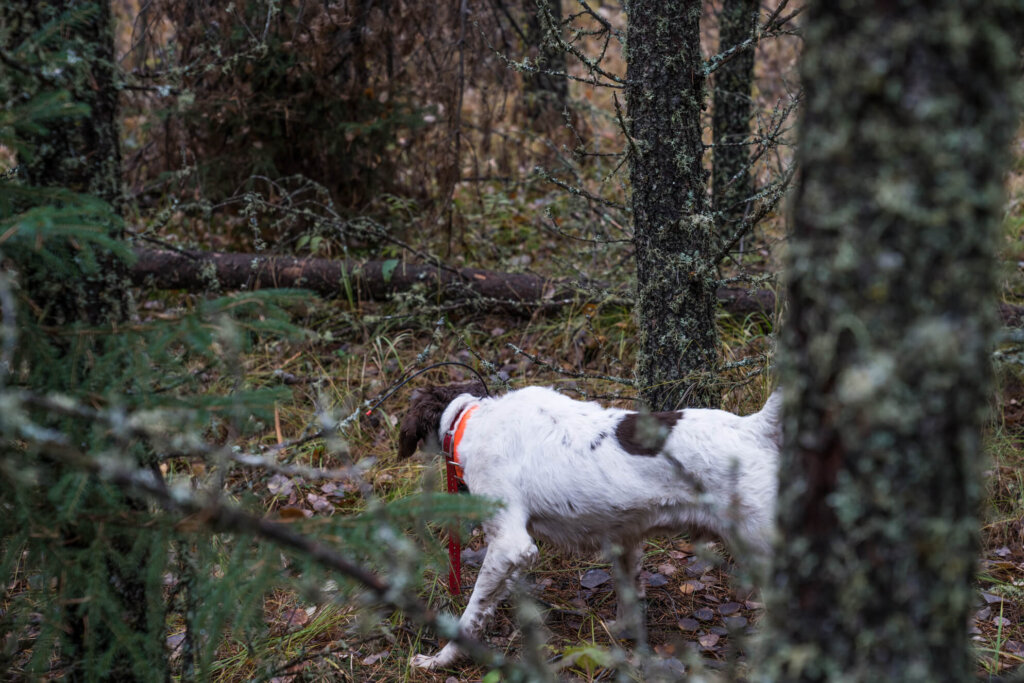
When hunting snipe, the plan would be for us to walk along the numerous beaver dams and rivers in the area looking for small mud flats that would hold snipe. Since the terrain was very open, we chose to just use one dog, Shooter, to go with us. It didn’t take very long before we put up our first snipe and much like a woodcock, a snipe’s flight path is very unpredictable. Snipe # 1 was a learning experience. We were not expecting our dogs to point a snipe as their smell is so different from anything our dogs have ever hunted in the past. With that in mind, we picked Shooter as he is a big area dog and covers a lot of territory. Shooter also does not mind mud and water, as the areas we were hunting would be very muddy and not much fun for less aggressive dogs.
As we walked along the river mud flats, Shooter put up a single snipe, I quickly swung and made a good shot and watched it fall right into the river. Shooter did his job. He waded in mud up to his chest before going into the river and he picked up the snipe and brought it back to me. As we continued along the mud flats, we put up a few more snipe. Dad and I both picked up a couple and Shooter did the retrieves. Our walk along the river mud flats turned out to be a very productive and we had one more species of the Upland Slam.
Even though the weather was nasty, we decided to head out in search of grouse near the more traditional aspen covered trails. I’d like to say that we got right into them, but the weather had the birds hunkered down and we only had one quick shot at a ruffed grouse during the rest of the hours of day one. I didn’t connect. Because the weather was nasty all day, we were not concerned about the lack of birds as we figured they were all up in the trees attempting to stay out of the rain and ice.
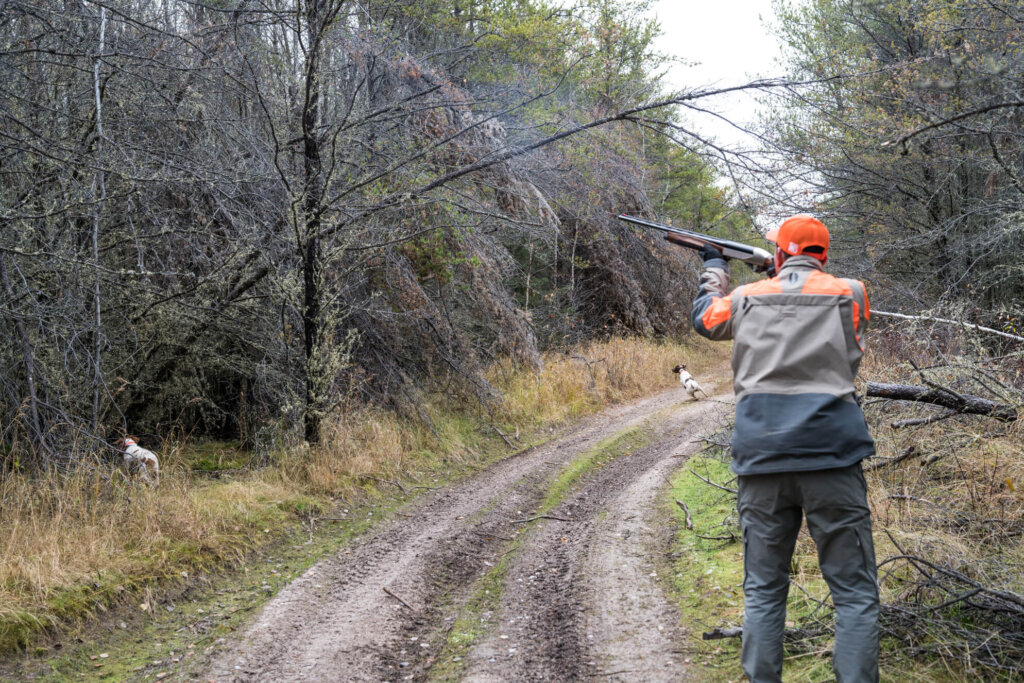
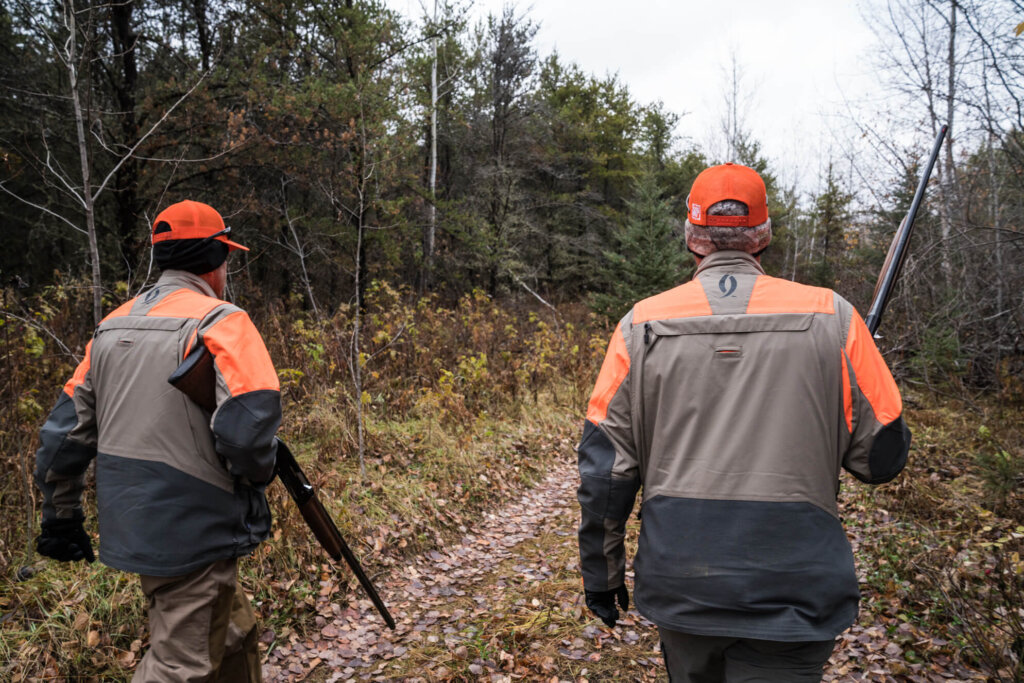
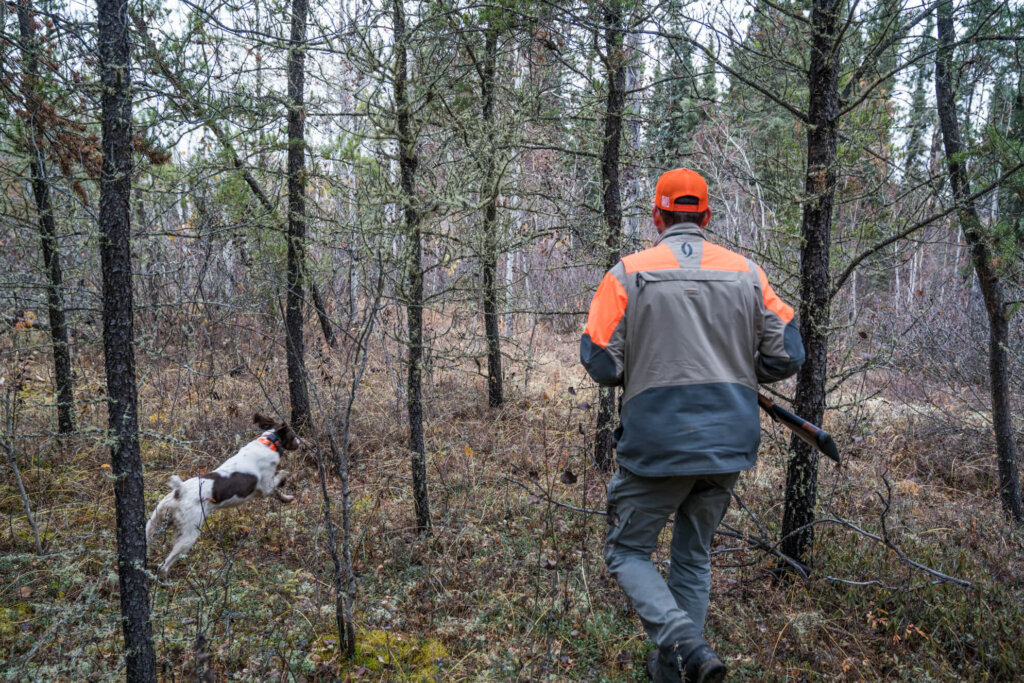
The next morning, we woke up to a clear crisp day; it was the type of day a bird hunter dreams about. There was a light wind, which was a perfect for the dogs to catch the scent of the grouse. The area we were hunting had the trees cut roughly 10 years before, but they had also left some standing pine as well. It truly was the ideal habitat for grouse. Our plan was to walk the winding two tracks left after the timber harvest. The cover was thick to each side, so for the first time on our trips this fall, we put bells on our dogs as we wouldn’t be able to see them most of the time. We would walk along the two tracks with the dogs quartering in front until we would hear a bell, or bells, stop. This signaled that a dog was on point.
This type of hunting is very similar to the type of grouse hunting that we do at home in Michigan. It didn’t take the dogs very long to pick up on what was going on. In short order we were in grouse. Moving along the two tracks, Tiny was working Dad’s side and Arrow was working mine. Arrow’s bell had stopped, so I went in on his location and found him on point. As I walked in, I tried to pick an open path which would allow me a shot. As I slowly moved alongside Arrow, his eyes were locked in front. I stepped in front of him, trying to locate the bird on the ground. I couldn’t see it, so I gave Arrow his release command and stood ready.
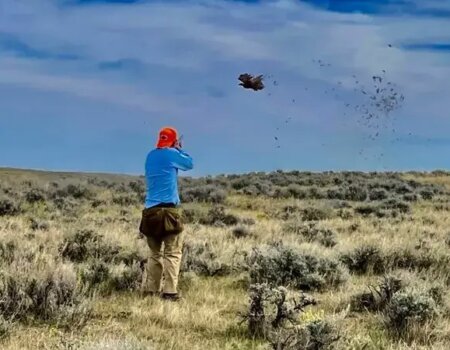
Arrow moved forward about 10 feet and a Ruffed Grouse took off on a right to left. I quickly swung and instantly knew, upon pulling the trigger, that the shot was true. After the bird dropped, I looked back over at Arrow and he was on point again. I walked over and put up another Ruffed Grouse; again, the shot was true. As I was looking to mark the 2nd bird, I looked at Arrow and he was on point again. Could it be? I walked over and a 3rd grouse went up on a going away shot. As I watched the 3rd bird drop, I looked at my Benelli and its action was open. I realized I had, for the first time in my life, taken 3 Ruffed Grouse with 3 shots. I tried to think back on the last time that I had taken 3 ruffed grouse in the same day; it had to have been at least 10 years ago.
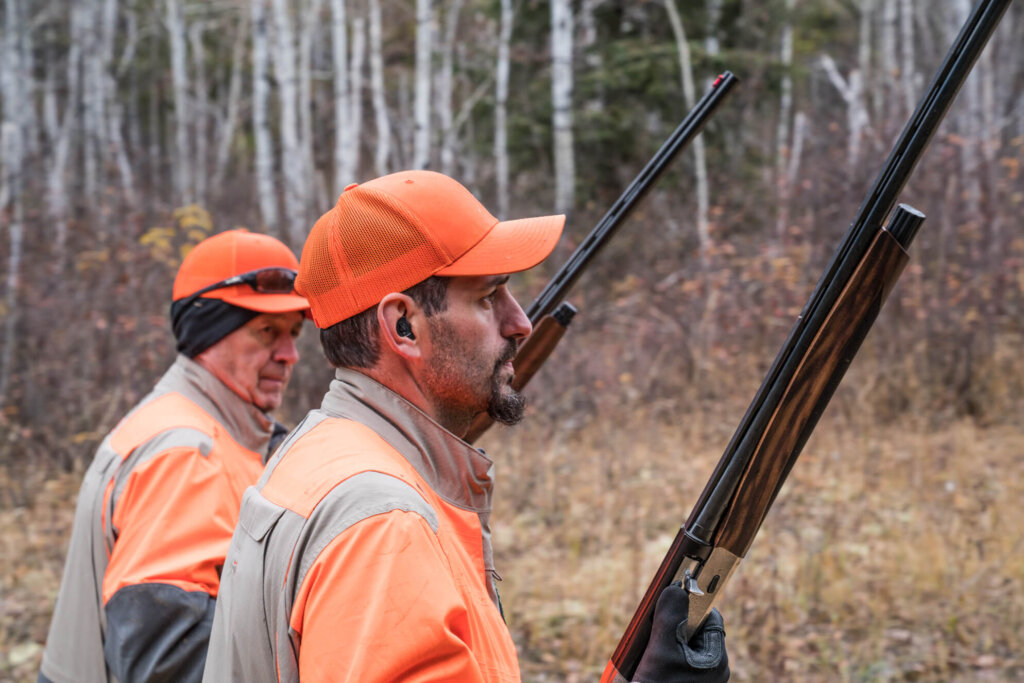
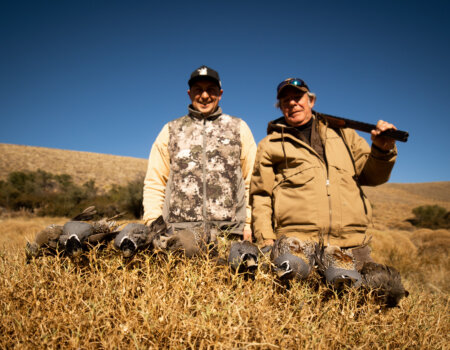
Dad and I continued this plan of walking the two tracks. It seemed like every few hundred yards, we would get into a different group of grouse. This was, by far, the highest density of grouse I have ever seen. As the dogs worked, they had a giant smile on their faces. They had spent much of their hunting life searching miles of cover in pursuit of Ruffed Grouse singles. As we headed back to the truck after the morning hunt, Dad and I had 14 Ruffed Grouse between us. Unlike where we are used to hunting, Saskatchewan has a limit of 10 Ruffed Grouse per day, per hunter. Dad’s comment to me was that during his entire life as a young hunter in Michigan, he had only reached the Michigan limit of 5, a few times. Here is Saskatchewan, he beat his personal best on his first morning grouse hunt.
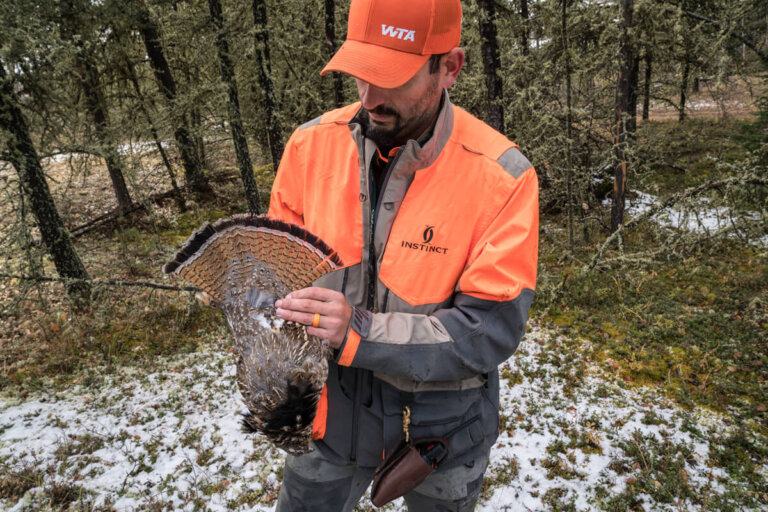
After a quick lunch, the afternoon plan was to head into some thicker pine cover in search of Spruce Grouse. Spruce Grouse are also known as Canada Grouse and inhabit much of the forest area bordering the northern most farmland. The Spruce Grouse are another reason we chose to hunt Saskatchewan; this was our only location to hunt this species. Again, it didn’t take long for us to get into grouse, but this time it was a Spruce Grouse that came out of the thick cover. I made a quick shot as the bird crossed in front of me. Tiny retrieved it and I was ecstatic to see a big male Spruce Grouse in her mouth as she made her way back.
With almost two months into the Upland Slam and seeing each of our dogs in all sorts of terrain, cover and birds, we were starting to get a very good idea of what each dog’s strengths and weaknesses are. Tiny is the ideal grouse dog as she is extremely careful and does not bump birds. As we moved along the two track, Tiny locked up on Dad’s side and a Spruce Grouse quickly followed. Dad made a great shot. This Spruce Grouse completed the grouse portion of the Upland Slam. This bird was also Tiny’s Grouse Slam. She was the only one of our dogs who successfully pointed and had each of the 6 species of grouse shot over her. Dad is planning to have all 6 grouse mounted and placed in a display at his home. He and Tiny will look at it, during the long, cold Michigan winters and remember the “fall of 2019”.
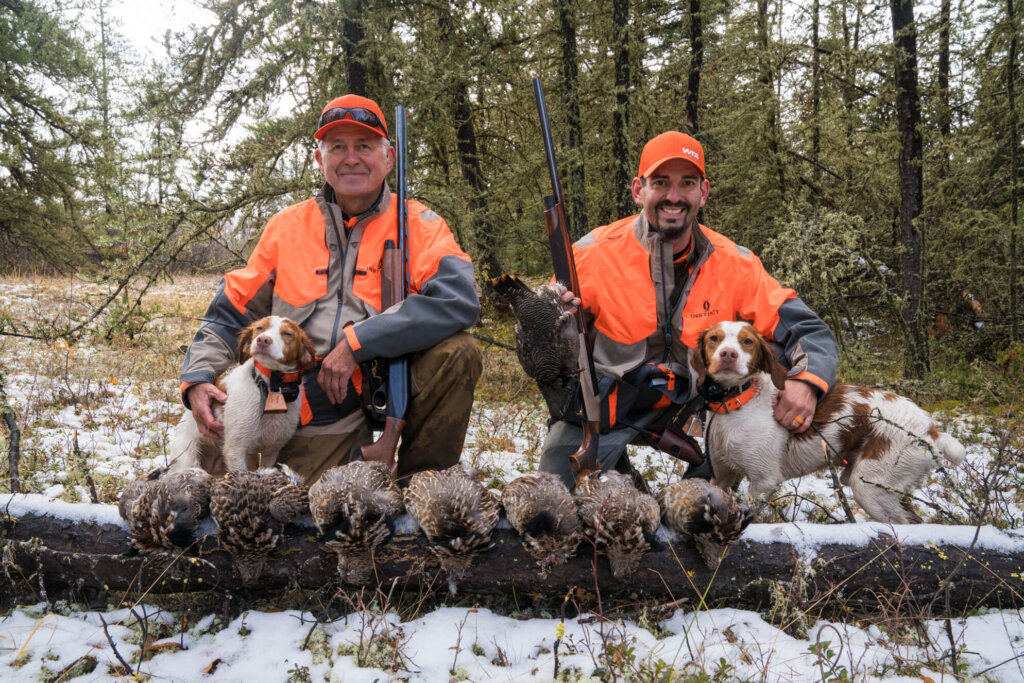
When I talk about knowing the strengths and weaknesses of the dogs, they have all played a vital role in our success thus far. They have had a lifetime worth of experiences and opportunities over the last couple of months. Here is a quick scouting report on our dogs. Shooter has a motor that never quits and he is the ideal dog for big open Western hunting. He covers a bunch of terrain and holds firm on points. He will retrieve any bird from any place. He carried us through Wyoming and without him, we wouldn’t have covered the necessary terrain to pick up the species we needed there. Tiny on the other hand, while not aggressive, has proven to be the ideal grouse and close working dog. She doesn’t bump birds and especially when Blue Grouse hunting, she worked close which was vital for our success on Dusky Blue Grouse and Sooty Blue Grouse. Now, I would put Arrow right in the middle. He can cover the miles if needed, but he can also work in tight if that is needed. He was truly having an amazing trip in South Dakota until his run in with the barbwire. This trip to Saskatchewan was his first hunt since that bad experience. He started a touch rusty, but by the end, he was firing on all cylinders.
Now, back to Saskatchewan grouse hunting. It is, hands down, the best place I have every hunted grouse. The habitat is ideal and the grouse population of both Ruffed Grouse and Spruce grouse is unmatched. The per hunter daily limit is 10 Ruffed Grouse, 10 Spruce Grouse and 4 Sharptail Grouse, for a total of 24. While we were there, we only saw 1 Sharptail but we did not hunt the farm fields nearby where they are located. The hunting in Saskatchewan must be what it was like to hunt generations ago in the Midwest. Very few hunters ever think of bringing their pointers to Saskatchewan. If you’re a bird hunter and want to experience your best grouse hunt ever, give Emily and Lance a call. Or, contact the team at WTA.