Book Your Adventure 1-800-346-8747

Karamoja; Land of the Buffalo

Tim Herald
|  

The Karamoja region of northern Uganda may best be known for the elephant hunting exploits of WD “Karamojo” Bell and his famous writings, but today this remote area derives its well-earned reputation from being what many experienced hunters consider the absolute best buffalo hunting on the Dark Continent.

I have been fortunate to hunt Karamoja four times over the past five years, and as an international hunt consultant for Worldwide Trophy Adventures, I have sent many clients to do the same. The region we hunt is operated by Christian Weth and UWS, and it is situated in extreme north Uganda where South Sudan, Uganda and Kenya all come together. The hunting concession borders Kidepo Valley National Park and is a picturesque locale mostly consisting of fairly open savannah interspersed with acacia and some low brush, and you are virtually surrounded by mountains in every direction. Buffalo surveys of the area have estimated a population of almost 10,000.

With the area being quite open, the buffalo hunting in Karamoja is more of a spot and stalk affair rather than a traditional tracking hunt. There are generally so many buffalo around, that you cover as much ground as possible by vehicle and glass as many buffalo as possible until you find what interested you. Then you try to formulate a plan to stalk within reasonable shooting distance, which in some cases is made quite difficult because the area is so open. That is not to say that there will not be situations where you can get close, but I would say the average shot on buffalo is from 80-100 yards.

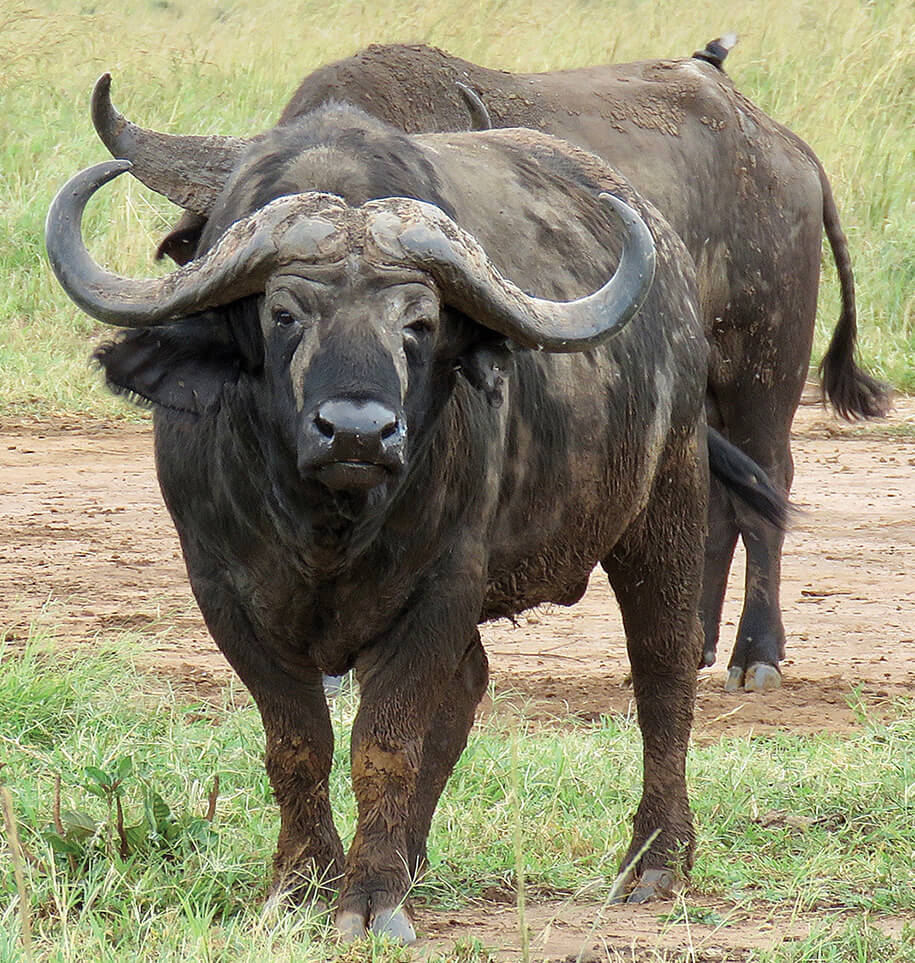
The areas buffalo are classified as Nile buffalo, and though they are supposed to be a bit smaller in body than Cape buffalo, there are some real tanks around. The first buffalo I ever shot in Karamoja back in 2017 was a beautiful 40” bull with heavy, chipped bosses, and classic Nile buffalo shape. He had a huge body, and when I got him home and mounted, the taxidermist told me that he had to use the largest Cape buffalo form made to fit my bull’s skin.

Typically, Nile buffalo have flatter horns than typical Cape buffalo, but like in most species, this can vary a lot. I have seen a number of Karamoja buffalo with very typical shaped horns, and even a few with beautifully deep drop.
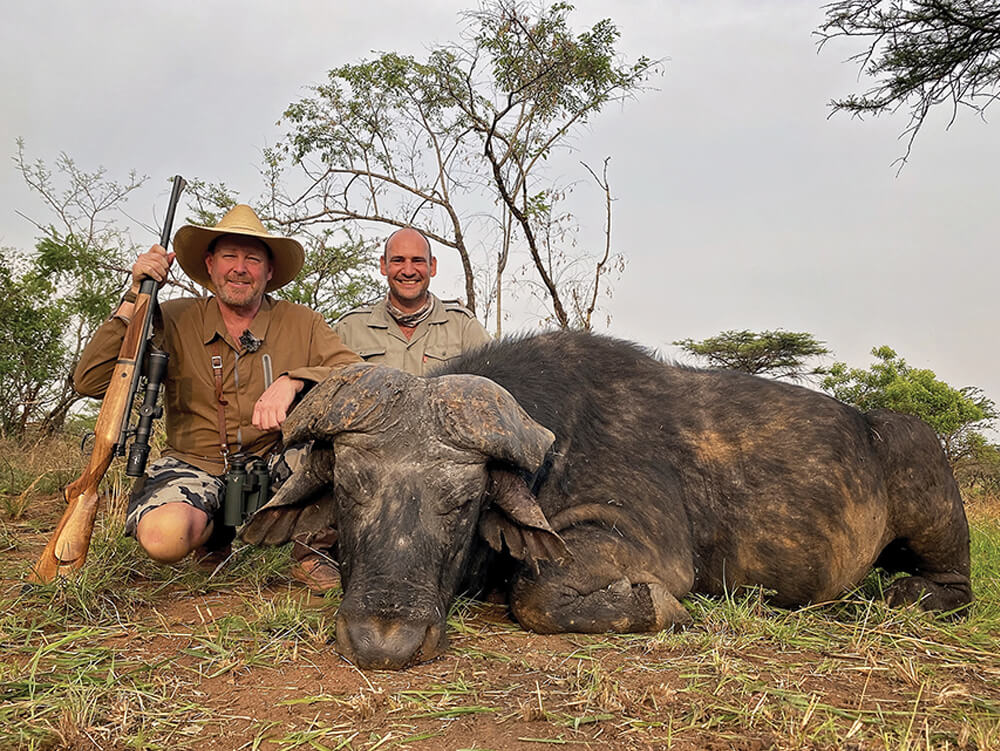
In 2020, I was hunting with good friend Tom Niederer and PH Edwin Young one afternoon, and we ventured up into some foothills. The terrain is more broken than on the main valley floor, and there is a fair amount of cover in that specific area. We eventually spotted two old bulls feeding a few hundred yards away, and as we glassed, Edwin told me he thought one bull was a “scrum cap”. For those that aren’t familiar with the term, a scrum cap is a bull that is so old, he has basically worn off all of his horns except his bosses. To me, this is the ultimate trophy, and I told Edwin I was more than game to pursue the bull.

We dropped into a dry creek bed, snaked our way closer to the feeding bulls, and crawled up a steep bank that ended up putting us at about 40 yards from the unsuspecting buffalo with the wind in our faces. Edwin put up the shooting sticks, and I settled the crosshairs of my scope low on the oldest bull’s shoulder and sent a 470 grain Cutting Edge Bullets’ Safari Raptor straight into his heart.

The bull bucked and lunged forward, and though he was dead on his feet, I put another in his backside as he retreated, and that put him down for good. When we walked up on the ancient old bull, I couldn’t have been more pleased. I think the old boy had to be over 15 years old, and though he is obviously the smallest buffalo I have ever taken, he is hands down my favorite. To take an animal that has lived that long evading the area’s lions and hunters is something special, and the bull’s body was worn down just like his horns, he was on his way out, way many years past being a breeder, and in my opinion is the perfect type of buffalo to take out of the population. There just aren’t many of those old guys to be found.

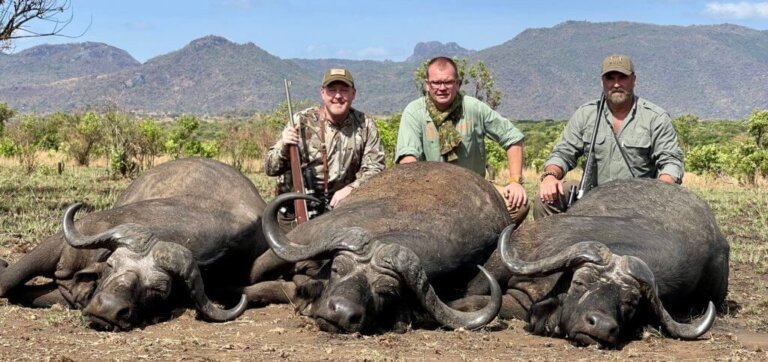
On that trip our timing was just perfect. It seemed that every buffalo in the area had left the park and was in our concession. We literally saw up to 2000 buffalo a day, and dozens upon dozens of mature bulls in groups of two to upwards of twelve. You could be very choosey on the type bulls you went after. Tom wanted wide, and he took 42” and 43” bulls. I wanted really old bulls, and I ended up with four nice old worn buff. Friends Russell and Mike were along as well, and they took three bulls each varying from very wide to deep drop, and both of them also took scrum caps. Four of us shot 12 great bulls in a week. It was literally buffalo heaven.
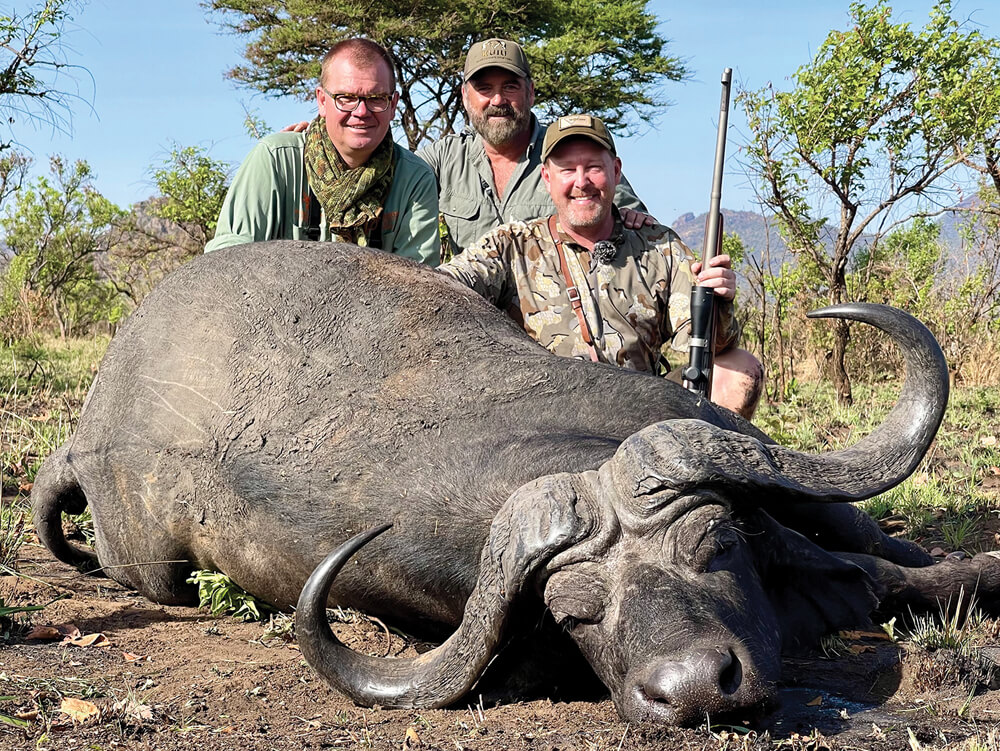
I returned in March of 2021 with longtime friend and WTA client Jay Cohea. We were on a short seven-day buffalo hunt, and Christian was our PH. The first evening we were in the area, and actually our hunt didn’t officially start until the next day, Jay took a really wide 43” bull. That kicked things off the right way.

A couple of days later after pursuing a group of bulls that evaded us with the wind, we got mixed up in a huge herd, and we decided to slowly walk back a couple of miles to the truck and see if we might run into some bulls that might have been trailing the herd. Eventually we did spot some buffalo, and the first two we saw were younger bulls, so we moved on. A few minutes later, Christina’s tracker Suliman spotted another bull up feeding, and we could see another bedded beyond him.

We slowly got the wind in our favor and crept closer to assess the bulls. Christian looked at the one up feeding and whispered back to me that it was a very big buffalo, and we needed to get a bit closer. We were able make it another 50 yards and pulled up under a small tree that gave us just a little cover.

The bull was actually walking toward us, and he stopped in some scattered trees about 75 yards away in a bit of shade. When Christian pulled up his bino, he told me that this was a really big bull, and I could tell he was quite excited. To be honest, I hadn’t studied the bull much up until then. I had seen that he was hard bossed, but he still had pointed tips, and in Karamoja, that is the first thing I look at. If a bull’s tips aren’t well worn, I usually don’t give him much thought, but as I focused in on this guy, I could tell he was something special. He was 100% fully hard bossed, had very good bosses, beautiful classic shape, and he was very wide, especially for a Nile buff.

I had my .416 on the sticks, but there was a small dead tree just in front of the bull that perfectly covered his vitals. If he took one step forward or had stopped one step back, I had the perfect shot. The bull stood there chewing his cud and was content, and I knew eventually he would step forward, and all would be good. After about 4 minutes, I felt the breeze on the back of my neck, and I knew things were about to get real.

The bull threw his nose up, took s deep sniff of human scent, and he wheeled around 180 degrees to leave. When he turned and opened up his shoulder to my view, I sent a 370 grain CEB into his lungs and he took off. With the area being pretty open, I was able to get a second shot in him and miss with a third. He stopped after about 100 yards with head hanging low, and I put one more in his lower chest to finish the deal. This is when things really got exciting.
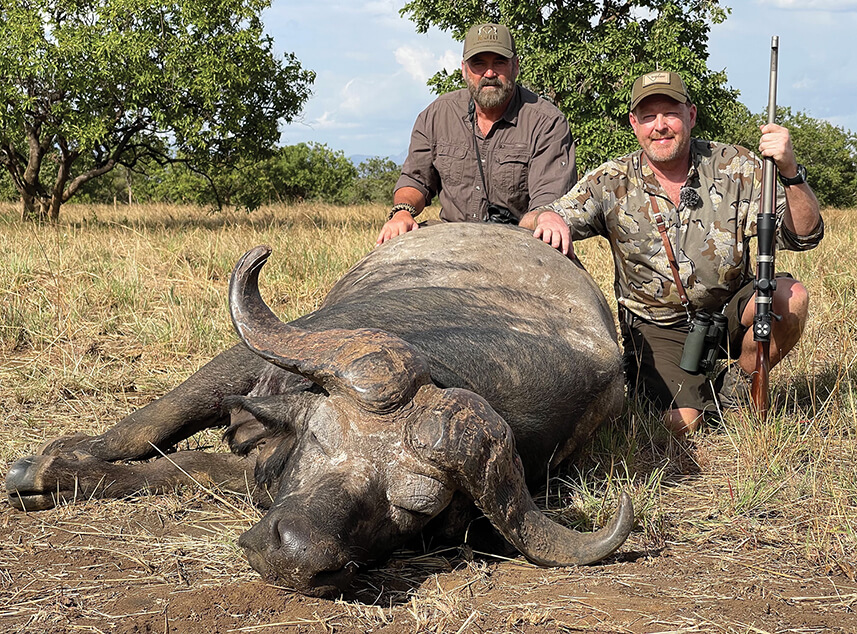
Not far from where my bull was lying, the bull we had seen bedded was up and standing looking back at us. He was an old slick horned brute, and Jay quickly took air and hammered him with his .460 Weatherby. Jay’s bull only went 50 yards, and from seemingly nowhere another bull appeared. He took off, but when Jay’s bull death bellowed, he turned, came back a few yards and stood looking back at us. He too was an old worn tipped warrior, and Jay wasted no time and dropped him in his tracks!

In a span of less than three minutes, we had three excellent buffalo on the ground, and we all just sort of looked at each other in disbelief. My bull ended up being 44” wide, and when measured would rank well into the top 10 of all Nile buffalo ever taken, but I am not a record book guy, so will not enter it. Jay’s two bulls were exactly what you want in Karamoja in my opinion. Both 12-13 years old (or possibly older), bosses worn slick, tips dulled with age, just perfect old bulls.

We called in another vehicle and more help, cut up the three bulls, and then went to a couple of close villages and distributed a lot of buffalo meat to the happy locals. We had quite the morning to say the least.

That afternoon as we were about to head out for the evening hunt, one of the skinners came and told Christian that he had seen a lone old bull feeding in the bush a few hundred yards behind the skinning shed. We decided to check it out and hoped the bull was still in the vicinity.
It didn’t take long for Suliman to spot the old bull feeding, and we slipped from bush to bush trying to get in position for a good shot. When we were at about 80 yards, Christian threw up the shooting sticks, and I got ready. The bull saw our movement and squared up on us, and I quickly put a CEB Raptor in his chest. He did a typical buck and forward lunge, and then turned right to run. Jay and I both simultaneously fired backup shots, and the bull rolled up on the spot.

He was another gray faced, super worn old bull that had been past his prime for years. Quite honestly, he is one of my favorite looking buffalo I have ever taken. It was St Patrick’s Day, Jay and I had taken two fantastic buffalo each, so we had a nice celebration in honor of our bulls that evening.

Jay went on to take another very nice bull a couple of days later and conclude our 2021 hunt. Karamoja is by far the best buffalo hunting I have ever experienced anywhere in Africa. The quantity and quality of bulls is just incredible, and that in combination with some unique plainsgame like Jackson’s hartebeest, East African Defassa waterbuck, Gunter’s dik-dik, and Haggart’s oribi, and the incredible beauty of the surrounding make Karamoja a must visit for the serious African hunter.

To book this or any other quality hunt around the world, contact Tim Herald at Worldwide Trophy Adventures,  tim@trophyadventures.com.

Recent Articles

Related Articles

Limited-Entry Alaska Dall Sheep: North America’s Pinnacle Hunt

Limited-Entry Alaska Dall Sheep: North America’s Pinnacle Hunt

As the December 15 deadline to apply for Alaska’s most coveted big-game tags approaches, one opportunity stands above all others: limited-entry Dall sheep. If you’ve ever dreamed of pursuing this iconic high-country species, now is the time to apply.

Why this Hunt Matters More than Ever

In the not-too-distant past, Alaska suffered back-to-back-to-back severe weather events that dramatically impacted Dall sheep populations across much of the state, resulting in fewer over-the-counter opportunities and even closures. Hunters have been forced to look to Canada, where hunts are now largely sold out through 2027 and prices have surged beyond $60,000. Even at such outrageous prices, availability is scarce.

This shift has made Alaska’s limited-entry draw areas for Dall sheep one of the most valuable options left for serious hunters. With hunts priced between $28,000 and $35,000, applicants can still access very high-quality white sheep at nearly half the cost of Canadian alternatives.

Exceptional Success Rates

Despite the challenges statewide, the limited-entry regions—managed by very conservative tag allocations—continue to produce outstanding results for the lucky applicants of WTA TAGS:

  • 100% shot opportunity during the past three seasons,
  • 90%+ harvest rates on mature rams,
  • Some of the largest Dall rams in North America.

For those willing to embrace the physical challenge, this hunt represents the ultimate North American mountain adventure.

Why…
My Alaska Range Grizzly Adventure

My Alaska Range Grizzly Adventure

I’ve been a bear hunter my whole life, but grizzly was always the dream. When the time finally came, I reached out to WTA to book a hunt. My someday hunt was finally becoming a reality. I thought I knew what I was hoping for: one good opportunity at a mature grizzly. What actually happened over those 10 days was beyond anything I could have imagined.

My journey began in Anchorage, where I stayed the night before flying into the bush. The outfitter has a liaison in town to help with any last-minute needs, so no rental car was needed. The next morning at Merrill Field, I boarded a turboprop (they use caravans, not tiny Super Cubs) for the 1½-hour flight into hunting country.

At the airstrip, the crew waited with Kong—a massive military deuce-and-a-half that can ford rivers, plus Polaris six-wheelers. After a stop at the roadhouse to organize, we headed to moose camp, about four miles upriver.

The camp itself told stories of 50 years of hunting. Cabin walls covered with dozens of hunters’ stories, as far back as the ’70s. Old regulation books showing $50 polar bear licenses. Boxes of ammo, left behind over decades for anyone who might need them. Four cabins with wood stoves surrounded the main lodge, and there was a creek-fed shower with endless hot water. A crate of beer stays ice-cold in the stream. It’s glorious. Remote Alaska with just enough comfort to keep you hunting hard every day.

From the roadhouse, we spotted two black bears on the mountainside. That evening, the cameraman Jordan and I glassed near camp, getting oriented for what was supposed to be a grizzly-focused hunt.

The next morning, those black bears were still there. We moved in. At 390 yards, with shifting thermals threatening to blow our approach, I took my shot. Low but lethal. Two more shots finished it. While butchering, we discovered this old boar was peppered with birdshot—dozens of pellets in each leg and shoulder. Somewhere, sometime, he’d been a problem bear. He could take a bullet. By 3 p.m., we had meat in the freezer and the hide salted. We were back to looking for grizzly.

Day two took us seven miles up the creek on six-wheelers, somewhat technical riding through river crossings and over rough terrain. Near the old sheep camp, we spotted a sow with three cubs and various black bears, but no boars.

Then everything changed. Rounding an alder-lined corner, our guide hit the brakes. A black bear ahead was acting strangely. It was actually approaching us. Behind him, a grizzly was hunting him, panting from the chase. The black bear, caught between predators, escaped up the cliffs.

The grizzly sat on its haunches, exhausted, looking between us and the black bear as it escaped. This bear was in full predator mode, seemingly calculating whether we might be easier prey. Then he simply lay down for a nap, 400 yards away, completely unconcerned by our presence.

For 34 minutes, I stayed behind the gun. Time passed slowly as we talked through every scenario: “If he does this, we’ll do that.” Finally, he stood and turned broadside at 415 yards. One squeeze, perfect shot placement. He barrel-rolled down the slope.

This was it—the animal I’d wanted forever, taken in a sequence I couldn’t have scripted better. Pure euphoria.

We had two bears down and over a week left of hunting. Day three was Jordan’s birthday, and we decided to get him a bear tag from camp. This would be his first hunt behind a rifle. We picked up a great black bear in no time. Jordan’s demeanor totally changed as he went into hunt mode and put a perfect 350-yard shot right into the bear’s heart. Top-tier birthday!

Three bears in three days with a week remaining. I bought a second tag and grabbed my bow. We spent four days searching for another bear, exploring drainages, following wolf tracks, catching Dolly Varden, and collecting shed antlers. Living the full Alaska experience while always hunting.

On the second-to-last day, I spotted a huge black bear doing loops through berry patches on a steep face. After multiple failed positioning attempts, I opted to go solo while Jordan and our guide filmed from a distance. The bear, hearing me crash through the alders below him, thought I was another bear invading his berries. At nine yards, with his hackles up and ears flat, I put an arrow through his front shoulder. Our group’s fourth bear.

Four bears in four days. An incredible adventure. This was the outfitter’s first year focusing on Fall bear hunting. The populations are thriving (evident from the moose without calves), and they’ve wisely increased tag allocations.

I came to Alaska with a lifelong dream of taking a grizzly. What I got was something I couldn’t have imagined: multiple species, incredible encounters, and memories that transformed a dream hunt into something beyond dreams. The grizzly lying down in front of us, completely unafraid. Jordan’s pure joy at his first bear. Stalking with my bow, close enough to hear the bear growling and clacking its jaws.

Some hunts meet your expectations. This one created new ones. When you book with WTA, you’re not just booking a hunt, you’re setting yourself up for adventures you can’t even imagine.

Learn about this Hunt

The Central Flyway is a waterfowl superhighway—a vital corridor for migrating ducks and geese—and for those of us lucky enough to be waterfowlers, it offers unmatched opportunities to hunt and experience the migration from September through January.

Over the past 40 years, I’ve had the privilege of chasing ducks around the world, but many of my favorite memories come from following this flyway, especially during those early years when my duck-obsessed father would pull my brother and me out of school every Fall to chase birds.

That’s right! We missed school every year for dedicated waterfowl trips. No regrets.

In the true north country, along the edges of Canada’s boreal forest, early-season hunts are nothing short of magical. The birds are just beginning their journey south—hungry, unpressured, and eager to settle into newly harvested grain fields. It’s a waterfowler’s paradise. The decoy spreads in these northern zones are often among the first the birds see, and their eager, uneducated responses can be absolutely breathtaking.

One of the most unforgettable sights is the famed swirling cyclone of Canada geese funneling down into a field. I can still hear my dad yelling over the deafening honks, his voice barely audible, “They can’t hear us!” The birds were so loud that those at the top of the funnel couldn’t even hear the gunfire below. If you’ve ever experienced it, you know exactly the kind of spine-tingling moment I’m talking about.

When the birds pushed south, so did we.

The prairie pothole regions of North Dakota are pure waterfowl gold. The right pothole on a cold morning—especially if you can find open water—can be magic. And if the water’s frozen? My dad had a fix: get there early, break trail through the skim ice, and push it under itself to create an opening. Voilà…open water.

I’ll never forget one frigid morning. After breaking ice, my hands were bright red and on the edge of frostbite. I looked at my dad for sympathy, but he just grinned as the puddle ducks cupped up and said, “Do you want warm hands, or do you want to shoot ducks?” Like I said, he was a fanatic. I grabbed the old Winchester pump and did my best. That day, I also learned the value of hand warmers and Gore-Tex gloves.

There are so many unforgettable moments:

  • Slipping and sliding at a Nebraska reservoir, laughing hysterically as we wondered if we’d ever get the old Suburban and trailer back up the icy boat ramp. After limiting out on greenheads.
  • Rowing across the Delta Marsh in the dark to find the perfect crescent-shaped bulrush island to set the decoys that the canvasbacks couldn’t resist.
  • Chasing snow geese in South Dakota and realizing we’d finally picked the perfect field, the one that made it worth all those hours spent spray-painting sheet-metal shell decoys in the garage.

These weren’t just hunting trips. They were memories shared with family, with friends, and with the great outdoors itself.

In the end, missing a week of school every year was worth every single minute.

The last duck hunt I shared with my admittedly duck-crazy father was a world away and half a lifetime ago. The hunt may be long over, but the memory will always stay with me.

At WTA, we’re proud to connect our clients with trusted partners so they can experience these same one-of-a-kind adventures.

We offer incredible destinations and outstanding outfitters all along the Central Flyway—from Alberta and Saskatchewan to North Dakota, South Dakota, Nebraska, Kansas, and Oklahoma—so you can create your own lasting memories.

Call Worldwide Trophy Adventures at 1-800-346-8747 today to book your trip of a lifetime.

See Central Flyway Hunts

Get Trip Specials & Cancellations,
Right Where You Want It.

No spam. Just the good stuff. Opt-out anytime.