Book Your Adventure 1-800-346-8747

Triple Threat: Brown Bear Rifle

Mark Peterson
|  
Species: Brown Bear
Method of Take: Rifle

Mark Peterson’s Brown Bear Rifle hunt for his NA29x3 quest provides a great model for why you should be careful picking when and where you hunt for brown bears. He hopes this story will empower you to make the best decisions before and during your next brown bear hunt.

Brown Bear Hunt Areas

As many of you know, there are two areas known to consistently produce the biggest brown bears year after year: the Alaskan Peninsula and Kodiak Island. On this particular hunt, I was rifle hunting the Alaskan Peninsula. This particular area is known as a “four year area,” meaning if you harvest a brown bear, you have to wait four years before you can hunt bear there again. The season for brown bears on the Alaskan Peninsula is Fall on odd years and Spring on even years. I chose one of WTA’s best brown bear/Alaskan outfitters for this hunt, as I’m a believer in trying to eliminate as many variables as I can before getting to the field and picking the best outfitter in the area eliminates a ton of variables.

Types of Brown Bear Hunts

This was a Spring brown bear hunt, and I chose that because the bears are up and moving more as they search for sows. During the Spring, bears can be anywhere while they’re looking for sows. Think about whitetails during the rut; they’re all over the place in search of does. The same holds true to brown bears in the Spring. The bears tend to cruise hilltops to catch the scent of sows. Because of how large an area the bears roam in the Spring, it is better to hunt with a rifle or muzzleloader rather than a bow. It’s very different from Fall bear hunts. In the Fall, the bears are usually concentrated around rivers since they’re trying to put on weight for the winter, before they den up. This makes the Fall hunt a far better choice if you are going to be archery hunting.

On this hunt…

We got into the main lodge just as a bad storm came through. We ended up getting stuck in the lodge for three days. When there was a slight break in the weather, we took advantage by hopping in the small plane that took us to our spike camp. It consisted of two tents: one for the guide (which also served as the cooking tent) and one for myself and cameraman. You can’t hunt the day you fly in Alaska, so we took the rest of the day to get settled into camp.

Flight to Brown Bear Camp - Mark V Peterson
Flight to Brown Bear Camp

brown bear hunt camp - Mark V Peterson

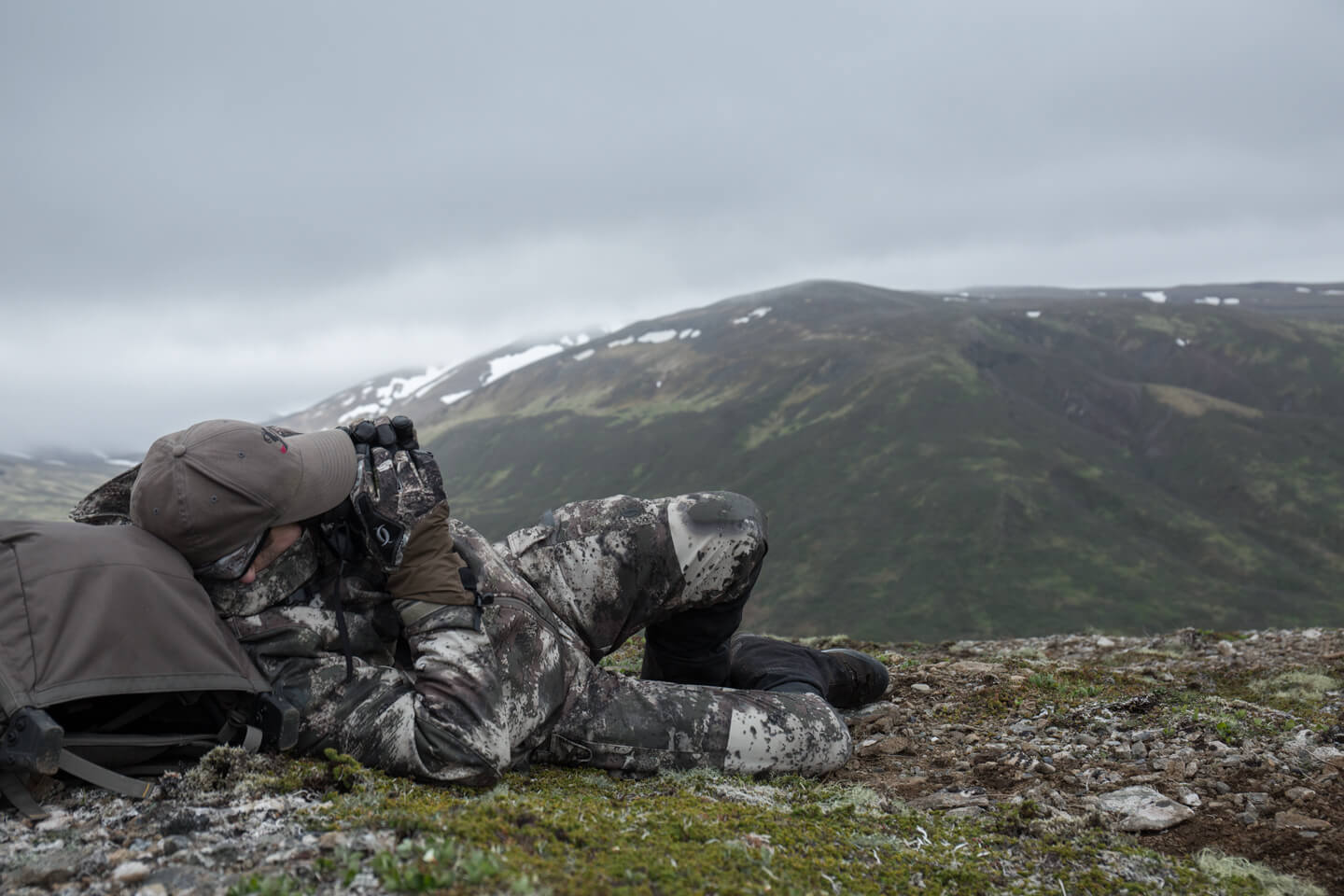
The next day, the weather was brutal, with rain and fog, but we still made it out to a glassing hill. The days during the Alaskan Spring are long. We ended up hunting & glassing for about 18 hours. We saw two bears off in the distance, but they were too far away to really see their size, and we couldn’t move closer. The next day, we woke up to sunny skies, and instantly we knew it was going to be a good day.
glassing for brown bear - Mark V Peterson
glassing for brown bear

Glassing

We glassed up an 8-foot bear on the walk from spike camp to our glassing hill. It only took a couple hours after we got to the hill before we spotted a giant bear coming over a mountain top. Luckily, it was heading in our general direction. We moved quickly to get in a position to cut him off. When we were finally in position, I aimed, and I took my shot from 250 yards. Luckily, I was able to get a steady rest and placed a good shot. This is more necessary than with less-dangerous game animals, as making a good shot on a brown bear is a must. A wounded brown bear can become a very dangerous situation in a hurry.

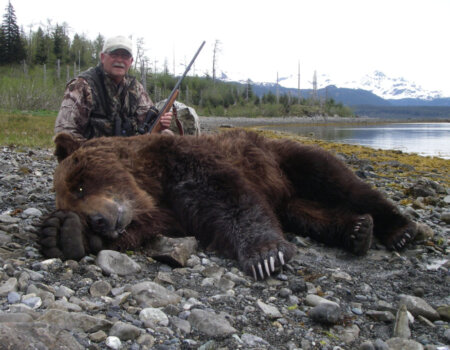
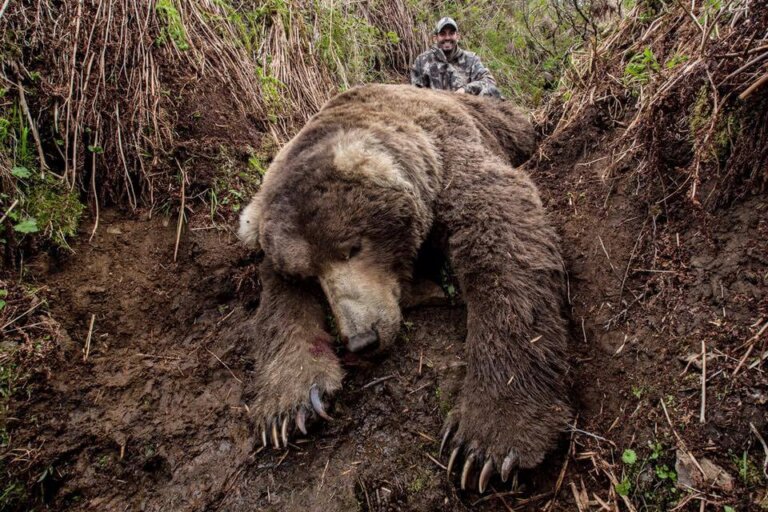
My bear squared over 10 feet and I am guessing weighed about 1,400 pounds. The hide alone weighed well over 120 pounds as we weighed it before we got on the plane from our main camp back to Anchorage. As you can imagine, the pack back to camp was pretty brutal.

Mark V Peterson with Alaskan Brown Bear
Mark showing off the size of his brown bear’s paws

Learn from My Experience

Brown bear hunting is tough, and I came into this hunt expecting to be in the field for 10+ days. But, with hunting, sometimes you get lucky and sometimes you don’t. This is one of the times I definitely was lucky. On brown bear hunts you need to expect bad weather, cold temperatures, high winds and lots of time in the tent because of rain and snow. The outfitter said it best—he doesn’t sell a guaranteed brown bear hunt. He sells cold, wet, and miserable! I’m booked to come back with this outfitter in 4 years to go after a brown bear with my muzzleloader, and I cannot wait!

glassing for brown bear - Mark V Peterson
glassing for brown bear


All the best in the great outdoors,
Mark
www.markvpeterson.com


Recent Articles

Popular Brown Bear Hunts

WTA Exclusive
Black Bear, Brown Bear   ·
Alaska
From 
$8,500
Outfitter #1071
Draw Required
Brown Bear   ·
Alaska
From 
$24,000
Outfitter #1047

Related Articles

Chasing Waterfowl from North to South

Chasing Waterfowl from North to South

The Central Flyway is a waterfowl superhighway—a vital corridor for migrating ducks and geese—and for those of us lucky enough to be waterfowlers, it offers unmatched opportunities to hunt and experience the migration from September through January.

Over the past 40 years, I’ve had the privilege of chasing ducks around the world, but many of my favorite memories come from following this flyway, especially during those early years when my duck-obsessed father would pull my brother and me out of school every Fall to chase birds.

That’s right! We missed school every year for dedicated waterfowl trips. No regrets.

In the true north country, along the edges of Canada’s boreal forest, early-season hunts are nothing short of magical. The birds are just beginning their journey south—hungry, unpressured, and eager to settle into newly harvested grain fields. It’s a waterfowler’s paradise. The decoy spreads in these northern zones are often among the first the birds see, and their eager, uneducated responses can be absolutely breathtaking.

One of the most unforgettable sights is the famed swirling cyclone of Canada geese funneling down into a field. I can still hear my dad yelling over the deafening honks, his voice barely audible, “They can’t hear us!” The birds were so loud that those at the top of the funnel couldn’t even hear the gunfire below. If you’ve ever experienced it, you know exactly the kind of spine-tingling moment I’m talking about.

When the birds pushed south, so did we.

The prairie pothole regions of North Dakota are pure waterfowl gold. The right pothole on a cold morning—especially if you can find open water—can be magic. And if the water’s frozen? My dad had a fix: get there early, break trail through the skim ice, and push it under itself to create an opening. Voilà…open water.

I’ll never forget one frigid morning. After breaking ice, my hands were bright red and on the edge of frostbite. I looked at my dad for sympathy, but he just grinned as the puddle ducks cupped up and said, “Do you want warm hands, or do you want to shoot ducks?” Like I said, he was a fanatic. I grabbed the old Winchester pump and did my best. That day, I also learned the value of hand warmers and Gore-Tex gloves.

There are so many unforgettable moments:

  • Slipping and sliding at a Nebraska reservoir, laughing hysterically as we wondered if we’d ever get the old Suburban and trailer back up the icy boat ramp. After limiting out on greenheads.
  • Rowing across the Delta Marsh in the dark to find the perfect crescent-shaped bulrush island to set the decoys that the canvasbacks couldn’t resist.
  • Chasing snow geese in South Dakota and realizing we’d finally picked the perfect field, the one that made it worth all those hours spent spray-painting sheet-metal shell decoys in the garage.

These weren’t just hunting trips. They were memories shared with family, with friends, and with the great outdoors itself.

In the end, missing a week of school every year was worth every single minute.

The last duck hunt I shared with my admittedly duck-crazy father was a world away and half a lifetime ago. The hunt may be long over, but the memory will always stay with me.

At WTA, we’re proud to connect our clients with trusted partners so they can experience these same one-of-a-kind adventures.

We offer incredible destinations and outstanding outfitters all along the Central Flyway—from Alberta and Saskatchewan to North Dakota, South Dakota, Nebraska, Kansas, and Oklahoma—so you can create your own lasting memories.

Call Worldwide Trophy Adventures at 1-800-346-8747 today to book your trip of a lifetime.

See Central Flyway Hunts
The Return of the Golden Age of Dove Hunting in Argentina

The Return of the Golden Age of Dove Hunting in Argentina

Argentina has long been celebrated as a premier destination for wingshooting, particularly dove hunting. The sheer volume of doves that flock to the skies year-round has drawn hunters from around the globe who are eager for a top-tier hunt. With over 20 years of experience in the industry, I’ve witnessed firsthand why many consider Argentina to be home to the best shotgunning experiences on the planet.

A New Dawn in Entre Rios

WTA has collaborated with one of the pioneers of dove hunting in Cordoba who has recently expanded operations to the stunning province of Entre Rios. This new location has quickly become the gold standard for high-volume dove shooting. With decades of experience, this outfitter and their dedicated team have built an extraordinary destination, boasting some of the most impressive dove flights seen in years.

Entre Rios is home to multiple roosts, each housing millions of birds. The proximity of these roosts to the lodge means minimal travel time to the hunting fields, allowing clients to maximize their shooting opportunities. You can expect to shoot as much as you desire, making this a truly unparalleled experience.


Convenient Access

Getting to Entre Rios is a breeze. Located just a 2 ½-hour drive from Buenos Aires International Airport, clients can take direct overnight flights from several major U.S. cities, including Atlanta, Dallas, Houston, and Miami. By midday, you could be savoring authentic Argentine BBQ, complete with sausages and a variety of fresh cuts of beef, before heading out for your first afternoon of hunting.

Unmatched Service and Cuisine 

From the moment you arrive, expect nothing less than white-glove service. Argentina is renowned for its exceptional cuisine and hospitality, and this outfitter excels in providing multi-course meals and comfortable accommodations. With years of expertise, they elevate customer service to the highest standards, ensuring a memorable experience.

Beyond Dove Hunting

In addition to dove hunting, Argentina offers fantastic opportunities for duck hunting. The prairie pothole region of the Pampas is teeming with diverse species, and local hunting pressure is minimal. Guided by experienced professionals, these American-style decoy hunts are truly unforgettable. Combine this with exciting partridge hunting behind well-trained pointing dogs, and you have a perfect opportunity for a mixed hunt during the winter months of May through August.

Experience the Golden Age

Don’t miss your chance to experience the resurgence of high-volume wingshooting in Argentina. With convenient travel options and unparalleled service, this is an adventure every wing shooter should have on their bucket list. Come and enjoy some of the finest hunting the world has to offer!

Learn More about this Hunt
Mexico’s World-Class Wingshooting

Mexico’s World-Class Wingshooting

For over three decades, Muy Grande Outfitters has been the premier spot for wingshooters from all over the world. Tucked away in Hermosillo, Sonora just south of Arizona, this outfit’s deep local roots and deep commitment to quality and safety make it the ideal choice for hunters looking for action-packed bird hunting in Mexico’s beautiful and rugged terrain.

While Muy Grande is known for trophy mule deer hunts, their wingshooting is truly world-class. Specializing in dove hunting, they offer three and four-night packages hunting mourning, white-winged, and Eurasian doves. Muy Grande has access to Sonora’s best hunting ground and an amazing team of professionals, so it’s no surprise that their wingshooting has been so popular.

Upon your arrival, your team meets you at the airport and takes you directly to the lodge where a traditional Mexican lunch will be waiting for you. After you get settled in, you’ll head out for the afternoon hunt. In the field, you’re paired with a “bird boy” who keeps you stocked with ammo and retrieves your birds. The day caps off with another fantastic meal.

The upcoming days follow a similar rhythm. You’ll eat a hearty breakfast and then head out on the morning hunt. After a few hours in the field, you’ll head back to the lodge to rest up during lunch, before heading back out on the afternoon hunt. Muy Grande’s pros handle all of the logistics so you can focus solely on the hunt.

Mexico offers some unique advantages compared to other wingshooting destinations. For one, it’s incredibly accessible. If you’re flying from California, for example, you could leave in the morning and arrive in Mexico and be ready to hunt by noon. It’s a quick flight and easy entry compared to places like Argentina.

Mexico offers an exceptional hunting experience that stands up to those of Argentina. Hunters enjoy a fast-paced and exhilarating adventure. Muy Grande’s meticulously managed properties ensure abundant opportunities to bag your fill of birds, delivering a top-tier, dynamic hunt that meets the highest expectations.

If you want to mix it up, Muy Grande offers the option to add waterfowl hunts to your trip. Depending on rainfall and water levels, you might encounter teal, pintails, mallards, and even the elusive Mexican black duck. It’s a mixed bag of fun, with the exact species varying by season and conditions.

If you’re after something truly special, ask about adding quail or Pacific black brant hunts to your trip. Quail hunting is done on foot, tracking and flushing birds, while brant hunting takes place on the water. Both hunts depend on the season and weather, so it’s worth checking ahead to see what’s available during your stay.

Your home base is Muy Grande’s dedicated 12-room lodge. It’s a sweet setup with showers, a private chef, and an open bar. It’s the same spot used for big game hunts but primarily reserved for bird hunters. Comfortable and well-equipped, it’s just a 15-minute drive from the airport. It’s the perfect place for unwinding after a long day of hunting.

Muy Grande takes safety very seriously. Despite what you might hear in the news about Mexico, hunting with Muy Grande is as safe as hunting anywhere else. Their intimate knowledge of the region ensures all hunts take place in secure areas, and they handle everything from airport pickup to hunting licenses and shotgun permits. You should bring your own shotgun, but if you can’t, they have loaners on hand.

Muy Grande Outfitters has mastered the art of delivering top-notch, exciting hunts in Mexico, and their wingshooting packages are no exception. Whether you’re chasing doves, adding a waterfowl hunt, or pursuing the elusive Pacific brant, Muy Grande serves up an unforgettable experience with all the trimmings.

For hunters seeking a quick getaway with great wingshooting and first-rate lodging, Muy Grande Outfitters fits the bill perfectly. Reach out to WTA today to book your next wingshooting adventure in Mexico!

Book this Hunt

Get Trip Specials & Cancellations,
Right Where You Want It.

No spam. Just the good stuff. Opt-out anytime.