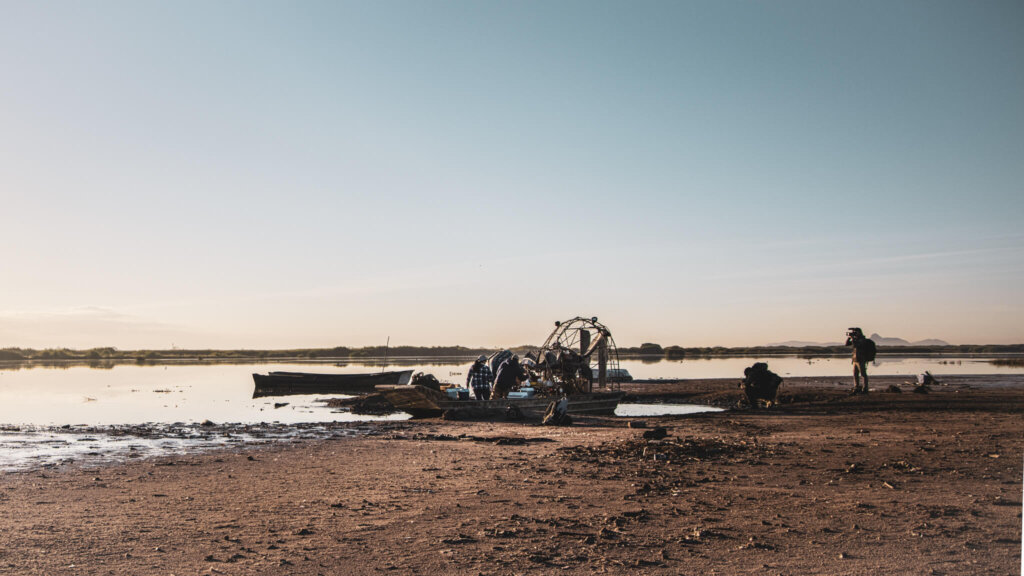
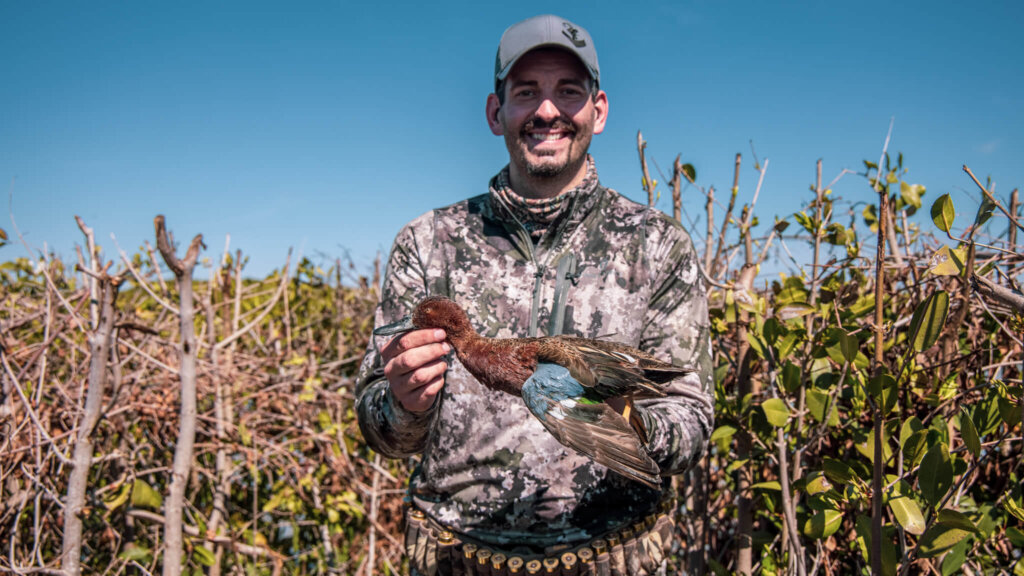
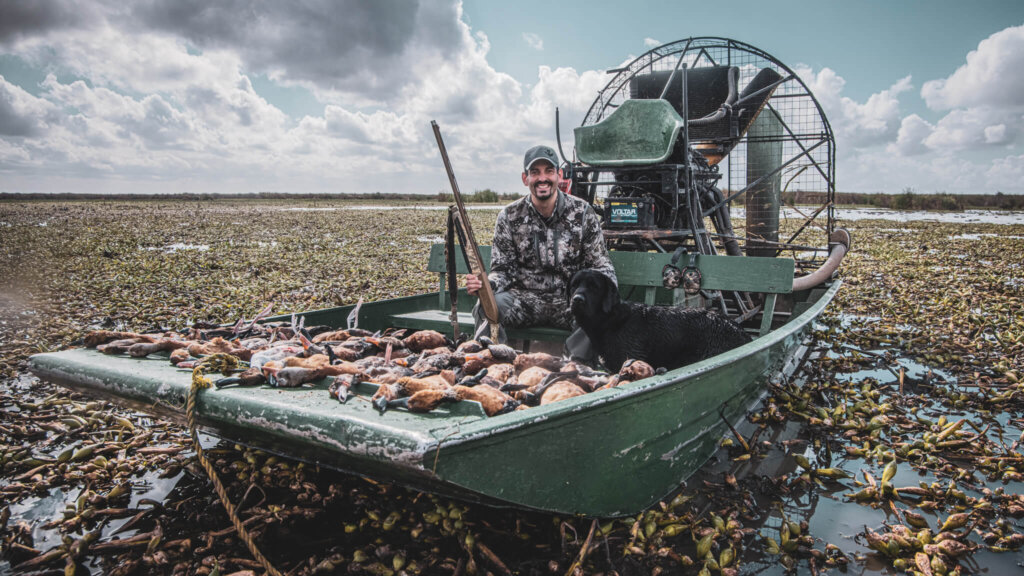
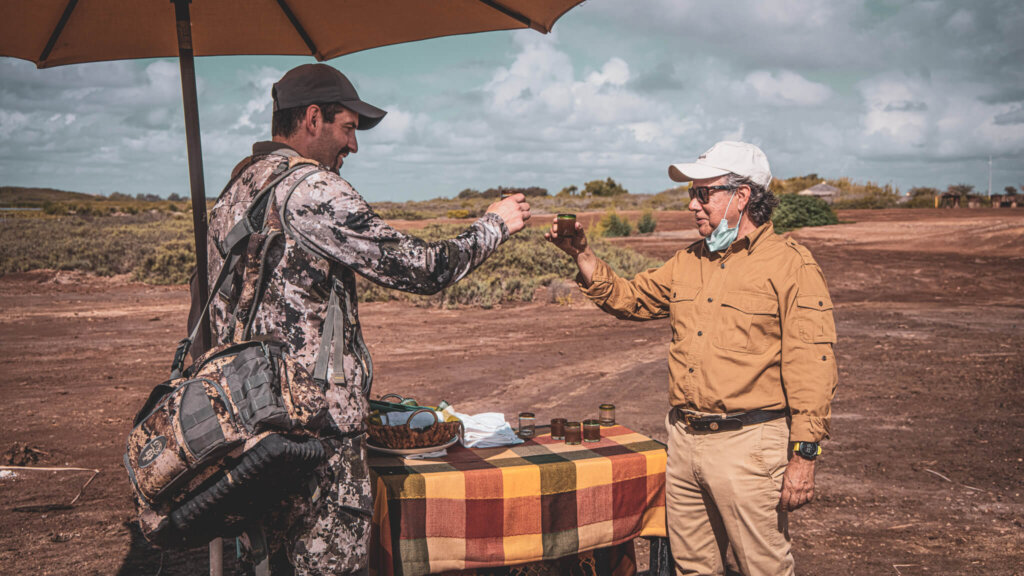


My target that first morning was a Cinnamon Teal. We arrived at a marsh just after sunrise, and David, our outfitter, took us on his airboat out to his blind, a series of pallets that formed a T shape. All sides of the blind were well concealed with natural brush. David put about fifty decoys out and told us to be ready for some action.
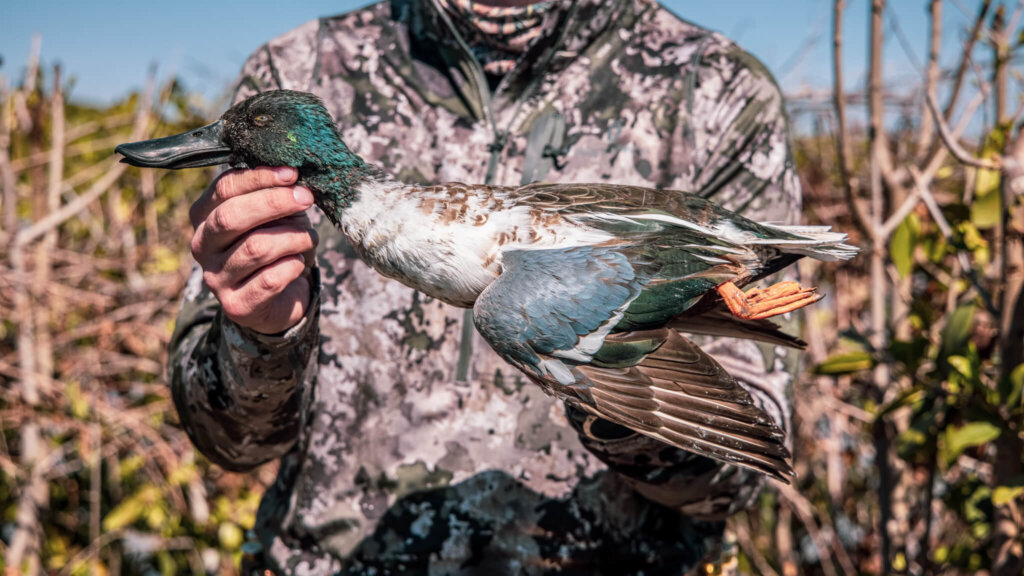
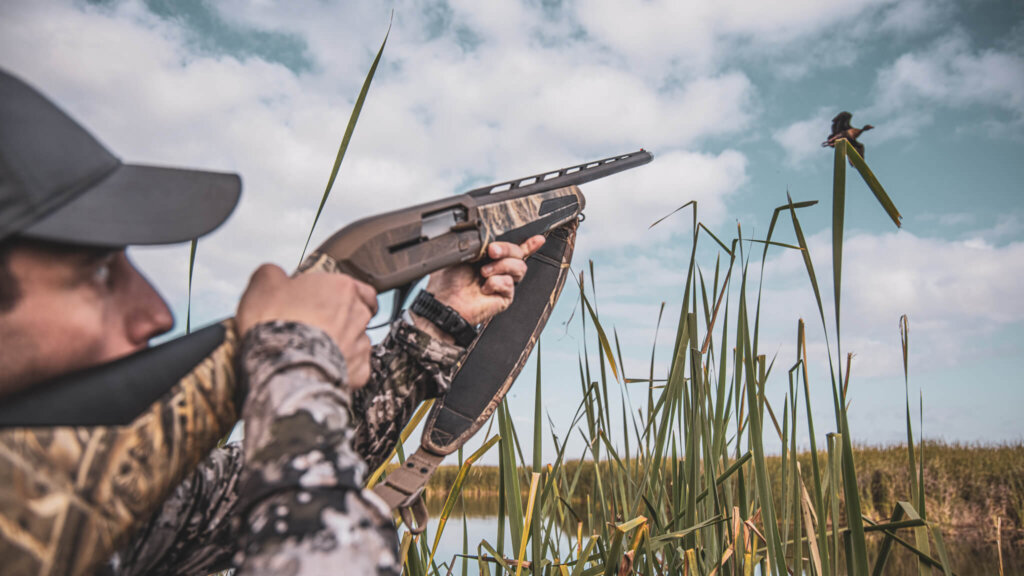
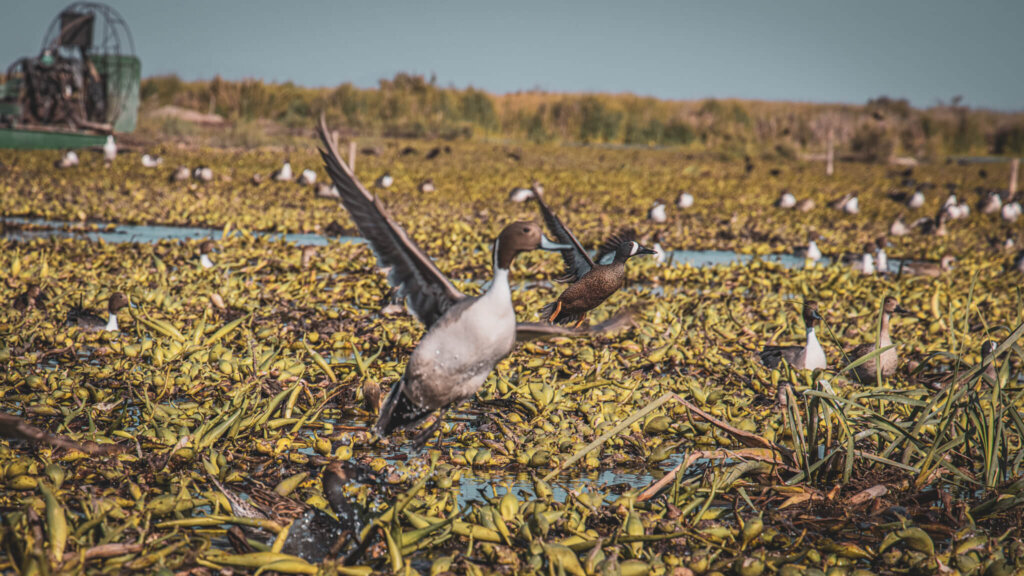
As soon as David left, ducks started flying—and they liked the looks of David’s decoy spread. Like most Mexican duck hunts, the waterfowl hadn’t been pressured too much. They would see our decoys and set their wings to come in. My first duck taken was a fully colored drake Northern Shoveler. I had already taken my Northern Shoveler for the Slam two months earlier in Sonora, but this one was much more beautiful. I planned to get him mounted. I also took a fully colored drake Blue-winged Teal and a drake Green-winged Teal. As with the Northern Shoveler, I had taken both these species earlier in the Slam, but these two had amazing colors and would also be saved for mounting.
After about two hours, a group of Shovelers cupped their wings coming in. I picked out a pair of drakes. Just before I took my first shot, about twenty yards away, a drake Cinnamon Teal peeled off from behind the Shovelers, heading to land in the decoys. Just as he cupped his wings, I took the shot—and Waterfowl Slam species number forty-one was down.
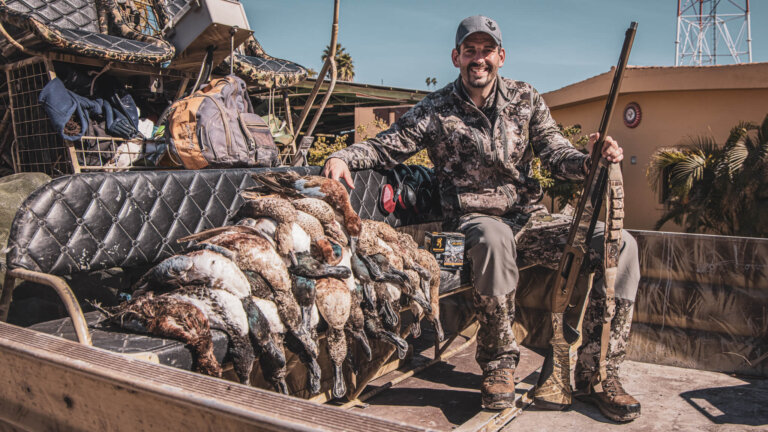
That morning was an excellent, action-packed hunt! I ended up with a mixed bag of Northern Shovelers, Green-winged Teal, Blue-winged Teal, and two Cinnamon Teal. It was a great start to my Los Mochis hunt. With the Cinnamon checked off my Slam list, our goal after lunch was to find whistling ducks. We drove around scouting fields and marshes. The Fulvous Whistling Duck was my last target needed in Sinaloa, and would leave me with a single species remaining to complete the North American Waterfowl Slam.
Whistling ducks generally move back and forth between fields and nearby marshy areas during the middle part of the day. We would stop at a field, glass the ducks there, and move on to the next field until we spotted my target. Unfortunately, we did not see a single Fulvous Whistling Duck the entire afternoon.
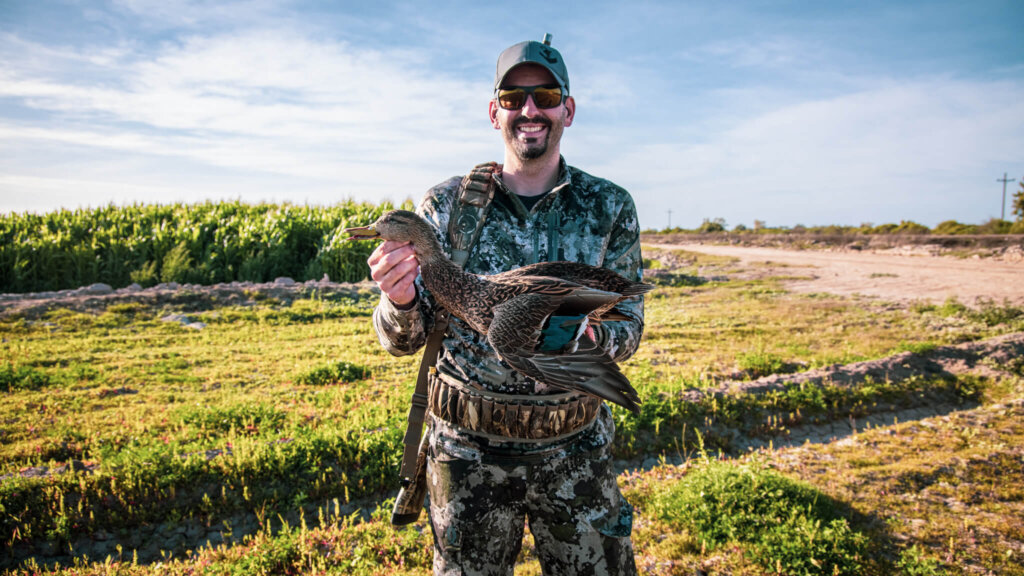
The afternoon was not a total bust, however. We were scouting a channel of water when I spotted a duck that I had not shot during my previous Slam hunts. I was able to make a sneak toward the channel and jump shoot a Mexican Mallard. He was a handsome, full-colored specimen. I had not included this subspecies of mallard on my list of the forty-three North American species, and considered the drake Mexican Mallard a bonus duck.
If my goal for this trip had been to shoot a whole bunch of ducks, I would have stayed and hunted for several days. Since my goal was a single Fulvous Whistling Duck, and they were nowhere to be found around Los Mochis, I needed to move on. It was obvious that they had moved farther south.
WTA put us in communication with Tony, an outfitter from Culiacán. Tony said he had good numbers of Fulvous Whistling Ducks near his lodge just outside the city of Culiacán. We decided to improvise and head farther south the next day. We landed at Culiacán’s regional airport the next afternoon.
The next morning we headed for a marshy area. “I have you in my best whistling duck blind,” Tony told us. I was very optimistic about the morning, as several whistling ducks took flight as we arrived. Within a few minutes, we had a great decoy spread set out and were in the blind, ready for ducks to start flying. Black-bellied Whistling Ducks and Fulvous Whistling Ducks came in together. I’d had many exceptional hunts this season. I had shot a lot of waterfowl and taken numerous species and subspecies during my quest to complete the Slam. My next statement is bold, but true. That morning’s hunt was, without a doubt, the best day of hunting since the Waterfowl Slam started.
Within ten minutes of being in the blind, I had dropped a Black-bellied Whistling Duck. Shortly after, numbers two and three for the morning were down—both Fulvous Whistling Ducks. I had successfully taken forty-two of the forty-three species needed to complete the Waterfowl Slam. The pressure was off, and it was time to relax, have fun, and enjoy the experience. We stayed in the blind for two and a half hours. I ended up with a mixed bag of Black-bellies, Fulvous, Pintail and a fully colored drake Blue-winged Teal.
After that amazing morning hunt, we returned to the lodge and faced an unexpected five-star lunch. The chef had a pig roasting over an open fire. The food was beyond good—that meal was the best lunch I have ever had while hunting. It was fitting—the best morning of hunting during the Waterfowl Slam, followed by the best lunch during the Waterfowl Slam. I remember thinking that if the day kept going that well, the sky was the limit with what could happen in the afternoon. Whatever was going to happen had to wait, though—after that meal, I wasn’t able to do anything before I had a nap!
After my siesta, Tony placed us in a blind where he said we would see “many, many Teal.” It was another outstanding hunt. I added two fully colored drake Cinnamon Teal to my bag of Blue-winged Teal and Northern Shovelers. With an hour of shooting light left, we moved to a new blind and Tony put a spread of decoys out. My bag continued to grow with additional Blue-winged, Shovelers, and one more Cinnamon. What a day! That’s the best way to describe it. I couldn’t have asked for a better day of hunting—or eating. Everything was amazing.
The next morning, we had time for a quick hunt before we needed to pack our things and head to the airport. It was another phenomenal morning. I ended up with another mixed bag. Before we left, we were each presented with gifts from Tony and his family. Receiving a gift from your outfitter is a common custom when hunting in Mexico.
Needless to say, Tony and his team received outstanding ratings from me. If you’re ever considering a waterfowl hunt in Mexico, you’ll have a great experience with Tony. WTA would love to arrange a hunt, and rest assured you’ll be taken care of. The accommodations, food and hunting are phenomenal!



The end of winter in the Northern Hemisphere gives me the itch to travel. I often visit Uganda to chase buffalo, before coming home for Spring turkey season. But this year, I switched it up. My wife, Alka, and I headed south to New Zealand for the last few days of February. We hosted two groups of hunters at two of WTA’s top outfitters and we all enjoyed a wonderful trip.
New Zealand offers endless opportunities for non-hunting companions while delivering a world-class hunting experience. Both lodges where we stayed had dedicated hosts who organized daily activities for the non-hunting guests. Shopping, visiting wineries, sightseeing in Mount Cook, jet boating, and many other activities filled the schedule. Once our hunts wrapped up, the guys joined the ladies on several of these excursions. I especially enjoyed spending a day exploring Mount Cook and an afternoon on the jet boat.
After flying to New Zealand and clearing customs, we caught a short flight to Queenstown. Queenstown is beautiful, situated on a lakeshore with steep mountains dropping straight to the water, making for postcard views. The local food scene is excellent. Alka and I tried multiple restaurants, checked out local shops, and rode the skylift to the top of the mountain. It was nice to have a day or two to acclimate to the 13-hour time difference.
We went to our first lodge, got settled in, visited the rifle range, and then had an incredible dinner.
Alka isn’t really a hunter. She has taken a few animals, and somehow I talked her into hunting a red stag. We got out at daylight with our excellent guide, Victor, when the stags were roaring. We looked at a couple of groups and crept over a ridge to glass into a creek bottom. We found stags roaring, fighting, feeding, and moving all over.
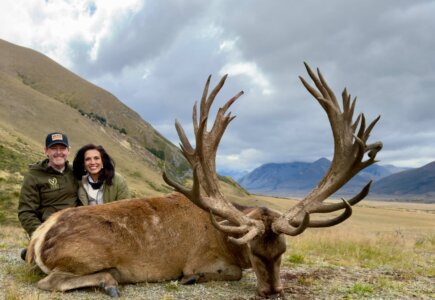
We finally decided on a beautiful red stag with a tank of a body, heavy mass, great crowns. And you could tell he was old. He was also dominant. The others gave way whenever he came near.
After a couple of hours, our stag bedded with another away from the others, and we decided to make a move. Victor expertly maneuvered us down into the thick creek bottom with the wind in our faces. Eventually, we moved within 100 yards of where we thought the stags were. After a while, the other stag stood up and repositioned. When he bedded again, Victor wanted to shift for a better angle. We ended up at 65 yards and could see our stag’s antler tips.
We waited 3 hours for the big guy to get up. We roared, threw rocks, raked brush, but he was tucked in and didn’t budge. Finally, in the early afternoon, Victor raked some brush, roared loudly, and the stag stood. Alka quickly got on the .30-06 and with a couple of shots an inch apart to the shoulder, the big stag dropped. Celebration time!
Alka got a super experience with lots of stag action, a great stalk in close, and then the nerve-racking wait for the 525″ stag to stand up and offer a shot.
Over the next few days, our group of hunters took some incredible stags and fallow deer. Toward the end, a few of us wanted to hunt tahr in the southern Alps.
I cannot describe how beautiful and rugged those mountains are, and seeing them from a helicopter is an experience not to be missed. My hunting partner and I both scored on nice bull tahr the morning we went out, and then the chopper pilot took the ladies up for a quick ride to show them the beauty and majesty of the southern Alps. It was a morning none of us will ever forget.
Alka and I then packed up and transferred to our next lodge, where we met four other couples, including our good friends Russell and Cindy. Russell and I were going to hunt together, as we have all over the globe, and again, the ladies had a full palette of fun excursions planned.
During the first afternoon, we saw a number of great stags and some incredible fallow. What really excited me was seeing and hearing bugling elk. We returned for a 5-star meal (Be ready to gain weight in New Zealand!) and prepared for the next day.
Just after daylight, we were on stags and moving around the hills and canyons, glassing and enjoying the views and the number of animals. One of the hardest parts of hunting there is choosing the stag you want to pursue. There are so many, and they are all so different, it’s sensory overload. There are wide, heavy, drop tines, typical frames, and every other antler configuration imaginable.
While glassing some stags in a wallow across a canyon, I spotted a big bull elk up on a ridge. He was so regal standing on the skyline, I kept coming back to him with my binos. I must have talked about him non-stop, because my outfitter and guide Shaun finally said, “We can go after him if you want, but he is about a mile away, and it’s all uphill.” I told Shaun I was ready to go if he was, so off we went, trekking up the mountain.
When we got to the top, we couldn’t find the bull. Huge rock formations blocked us from seeing a number of areas, so we slowly moved from rock to rock, carefully glassing, until we found the big bull on the third set of rocks.
I quickly set up and Shaun ranged the bull at a bit under 300 yards, moving away. Shaun has suppressed Gunwerks rifles available for his clients to use. I knew with that setup, the shot should be easy if the bull presented a good angle.
After watching him for a few minutes, the bull swung around, giving me a quartering away shot, and I tucked one in behind the shoulder. The big guy was done. When we got to him, he was way bigger than I thought, with 54″ beams and a huge frame, the 7×7 stretched the tape to 397″. I was ecstatic!
That afternoon, I went along with Russell on an exciting stag hunt where we got in on two great bulls. After a lot of maneuvering, they stepped out of a bedding area at 70 yards, and Russell hammered a beautiful stag with great crowns and kicker tines off both sides. Getting in close on these huge stags is an absolute blast.
The other guys in camp were laying down some great animals as well. On our second-to-last day, we all decided to go with the ladies for a jet boat ride up a glacial river, a short hike, and then a winery stop for apps and drinks. It was a fantastic day of seeing incredible scenery and relaxing with old and new friends.
On our last morning, Russell decided to find a good elk. An hour or so later, we found a big bull working a wallow. Russell and his guide made a stalk, Russ got on the sticks, and the next thing Shaun and I saw through our binos was the big heavy bull tipping over. What a great way to end our superb hunt!
We all headed back to Queenstown in the afternoon, had a great dinner at the Botswana Butchery restaurant, and then it was one sleep and a long flight home.
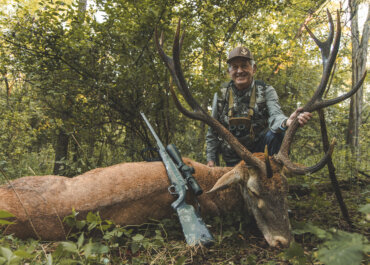
The roar cuts through morning mist like nothing you’ve heard before. Not the bugle of an elk or the grunt of a whitetail, but something primal and commanding that echoes off canyon walls and freezes you in place. It’s a sound you’ll never forget. Welcome to Croatia’s mountain hunting, where red stags rule kingdoms of stone and forest that stretch beyond horizons.
From Zagreb’s contrasts, where Habsburg elegance meets Yugoslavia’s concrete legacy, it’s a 1½-hour drive through rolling hills into the mountains. The road climbs past villages of a few hundred into country that feels genuinely wild. This is one of Europe’s last uninhabited places, where brown bears and wolves still roam freely and red stags grow huge.
Our mountain lodge sits in a valley that time seems to have forgotten. Built from local stone and timber, it serves as base camp for adventures across 100,000 acres of contiguous hunting ground. The setting alone justifies the trip. Peaks rising beyond peaks, morning fog filling valleys like lakes, and silence broken only by wind through pines and the distant roar of stags announcing their presence.
The accommodations may surprise anyone expecting rustic mountain camps. This is European mountain hunting, which means serious comfort after serious days afield. Our hosts bring genuine culinary experience to meals featuring local game, including brown bear sausage. This delicacy would shock American sensibilities, but it proves delicious when prepared by people who’ve perfected the art. The wine cellar doesn’t hurt either.
Late September puts us at the peak of the rut, when mature stags lose all caution in pursuit of genetic immortality. Their roars begin before dawn, rolling across valleys with an air of primal authority. Following those sounds leads to encounters that redefine what big game means. These Croatian red stags rival anything North America produces, but with an Old World majesty that feels almost royal.
Hunting varies with your ambitions. Valleys offer evening opportunities, where stags emerge to claim meadows and announce their dominance. For the adventurous, mountain hunting means serious climbs across terrain that would challenge sheep hunters, chasing roars that echo from ridge to ridge. Our guide Marco reads these mountains with a familiarity that only comes with time and calls stags with skills that border on art. His ability to bring a monarch within range through pure vocal mimicry must be witnessed to be believed.
The country itself tells stories. The clearing where we found fresh sign? Former Olympic training grounds from Yugoslavia’s era, now reclaimed by forest and wildlife. The abandoned ski runs make natural travel corridors for game while creating openings where morning encounters unfold like theater. History layers beneath every step, but the hunting remains timelessly authentic.
Brown bears add another dimension. Spring offers the largest specimens, but Fall hunting means frequent encounters while pursuing other species. From elevated blinds, we watch these giant predators emerge from shadows. The opportunity to add a European brown bear to a red stag hunt creates combinations unavailable anywhere else.
Success rates approach certainty when seasons align with your schedule. European game management focuses on ensuring animals are in the right area when seasons open, and the package system provides clear, transparent pricing. Pay for what you take rather than gambling on opportunity. It’s a model that brings world-class hunting within reach of normal budgets.
The fallow deer and mouflon add variety to days when stags prove elusive. During the rut, fallow bucks respond to calls with aggressive charges that create heart-stopping encounters. Their spotted coats and palmated antlers provide a striking contrast to the red stag’s noble bearing, while mouflon offer mountain hunting that rivals anything North America produces.
The predator exclusion areas deserve mention. Not high-fence hunting as most know it. It’s 4,000 acres of natural habitat protected from increasing wolf populations. Six-foot fences keep predators out while allowing stags to jump freely in and out. It’s game management focused on balance, ensuring healthy populations for generations.
Beyond hunting, the mountains offer sightseeing that rivals any European destination. Plitvice Lakes National Park, a day trip from our lodge, presents waterfalls and lakes so pristine that they seem otherworldly. Sixteen terraced lakes connected by waterfalls create one of Europe’s most photographed natural wonders, though photos fail to capture the reality.
What makes Croatian mountain hunting special isn’t just the game or the country, though both exceed expectations. It’s the complete immersion in hunting culture that dates to medieval times, where the experience matters as much as the outcome.
Standing on a ridge at sunrise, listening to stags roar across valleys that stretch to the horizon, you understand why this hunting creates addictions. The combination of Old World game management, stunning country, and genuine mountain hunting delivers experiences rarely matched by other locations.
These mountains hold more than game. They hold traditions worth preserving and experiences worth crossing oceans to pursue.
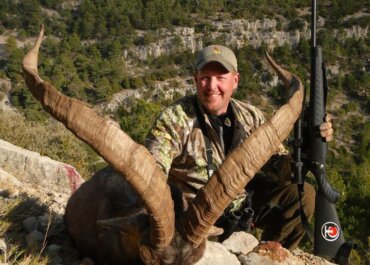
I have been hunting Europe for a little over 10 years now, but there are so many countries and so much game that I feel like it could take another 20 years to see and do everything I want to do. That’s part of what makes Europe so exciting. It truly feels endless. Europe has become incredibly popular for several reasons. First, as an international hunting destination, it is easily accessible, with numerous flights available and no 15-hour, long-haul flights required from the U.S. and North America. Second, the hunts are almost always 100% successful because game management is top-notch and populations are extremely healthy. Third, hunts are relatively short, usually three to five days. Hunts lend themselves perfectly to adding extra vacation time, bringing non-hunters, and enjoying a truly memorable overall trip.
I’ve had the privilege of running WTA-hosted trips designed specifically for couples for the past three years, and we will continue this program well into the future, due to its overwhelming popularity. These trips are structured with a primary hunt alongside a dedicated non-hunter program for observers who prefer not to spend time in the field. Some of these activities have included spa days, shopping excursions, guided sightseeing tours, visits to olive oil operations or wineries, and more. Of course, non-hunters are always welcome to join the hunters in the field if they’d like.
On a personal level, my wife absolutely loves these trips, and I wouldn’t think of traveling to Europe without her. On several occasions when I’ve finished my hunt early, I’ve joined the non-hunters on their excursions and had an absolute blast. We also typically add a couple of days at the beginning of the trip to explore a city or region we haven’t visited before, which helps us adjust to the time change before the hunt begins.