Throughout my life, when asked, “What’s your dream?” an Alaska-Yukon moose hunt was always in the top two—right up there with elk hunting. But as the years went on, I found contentment in local outdoor pursuits with my boys, living vicariously through buddies who had those monarchs displayed on their walls.
As I crept closer to 50 and toward empty-nester status, a sense of urgency set in. I had a bit of a panic attack realizing a few things:
- My main hunting partners, my sons, are becoming adults and forging their own paths. Time afield with them will become less.
- I’ve always told them to chase their dreams, yet I hadn’t chased mine.
- If I’m going to do this, it has to be soon, while my body’s still able.
I made a half-hearted call to Jason Berger, “just to inquire.” He might describe it more as a counseling session. I’ve known Jason for nearly two decades since my days at Cabela’s, and I trust him. He gave me a clear rundown of the realities when it comes to moose and elk hunts. We landed on the idea of a possible cancellation elk hunt “someday,” and I told him I’d get back to him.
Fast forward a few weeks to vacationing with my family in August. I got a text from Jason:
“You ready to head North?”
My heart fluttered with both excitement and fear. I called him right away. There was a cancellation for a moose hunt with Yukon Peak Outfitters—and the price was reduced. The kicker? The hunt was less than a month away!
Jason walked me through the pros and cons. This would be Yukon Peak’s first hunt of the season, starting on September 10. That meant fresh guides and fewer chances that bad weather would blow the hunt. On the flip side, moose can be tougher to find early, especially if it’s warm and the rut hasn’t kicked in yet.
I knew this opportunity wouldn’t last long, and I had to make a decision. It felt selfish, and I wrestled with it. Then my spirited middle son chimed in, “Dad, if you don’t do this, I’ll never talk to you again.” I think he was joking. Maybe. Either way, I took the nudge. With the full support of my kids and my encouraging wife Camille, I said, “Let’s do it.”
Then the clock started ticking. It was overwhelming at first, but with help from WTA, Yukon Peak, and a few patient friends, I quickly figured out what I needed to do. I’m not ashamed to admit I needed some serious handholding. Without WTA managing the logistics, it could’ve been a disaster. They understood issues I didn’t have time to learn on my own. They booked my flights to Whitehorse, Yukon Territory, making sure I had enough layover time for customs and the joys of traveling internationally with a firearm. I was in good hands.
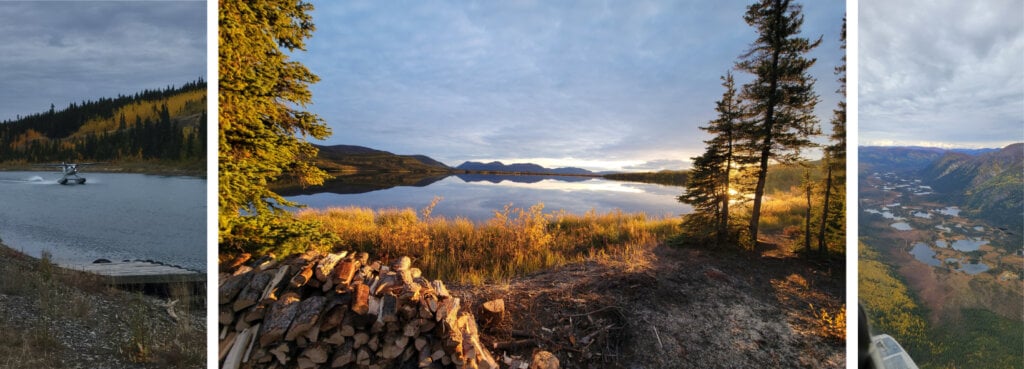
After a long day of connections through Denver and Vancouver, I landed in Whitehorse and was greeted by Rose from Yukon Peak. She took me to overnight at a local hotel. The next morning, Tom O’Grady, the outfitter’s father, drove me and another hunter north about three hours along the breathtaking Alcan Highway to base camp. There, I met Nathan O’Grady, the outfitter, and Colston, my packer. As we heard the buzz of the floatplane coming up the river, we loaded up and took off toward the remote lake that would be our backcountry base. The scenery was breathtaking, a dotted landscape of water and mountains.
We landed on a remote lake and spotted a wall tent along the shore. There I met my guide, Derek, who at first glance looked like a full-on lumberjack. I’d heard stories about hunters not having chemistry with guides, but with Derek, I knew that we’d get along. His sarcastic, childlike humor matched mine and he’d be a friend.
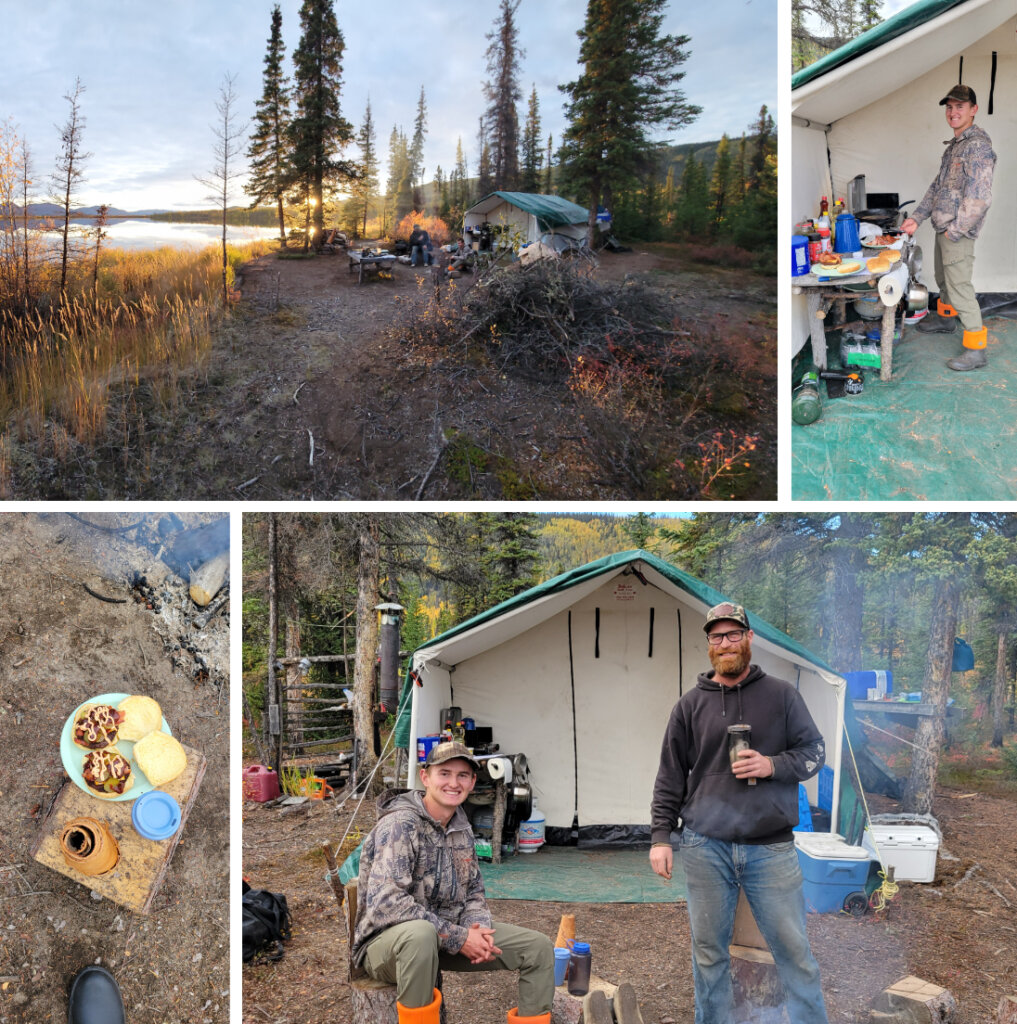
Derek asked plenty of questions to assess my fitness, shooting ability, and expectations. That conversation turned out to be key to setting me up for success. He pointed out some calling spots on nearby hills. I looked at them and thought, “That doesn’t look like too much of a climb…this should be easy.”
Day One. Reality Check.
We hiked up to one of those knobs. I was quickly humbled, slogging through wet, clumpy terrain, then crawling over deadfall and thick vegetation as we climbed. Derek, turning with his .44-70 “walking stick” (aka bear repellent), would grin and ask, “You OK, man?” I’d grunt back a labored “Yes,” with drool and snot covering my face.
To be clear, I’m not complaining. Everyone warned me. And no, this wasn’t a sheep hunt. If you’re in decent shape, you’ll be fine—but do a gut check and train. Still, I enjoyed every bit of the effort this hunt required.
It was warm with temps in the 60s. We spent the day cow-calling and glassing the valleys near camp. No moose. Derek stayed upbeat: “It’s a seven-day hunt. Don’t worry. They’ll be here.”
Day Two
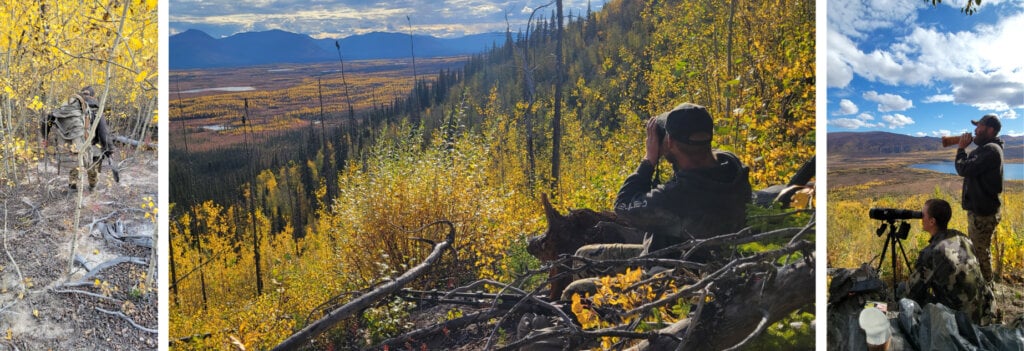
We crossed the lake by boat to another calling spot. After a couple of hours, we spotted our first moose: a cow. Relief washed over me. There are moose here. A while later, we spotted a sow grizzly following the same shoreline path as our camp… unsettling. Not long after, Derek picked out two bulls over three miles away. How he spotted them, I’ll never know. Even with the spotting scope, I struggled to see them.
The good news? We were seeing bulls. The bad news? It was late in the day. If we went after them, we’d be sleeping in the bush, with no chance of the floatplane landing nearby. The pack-out would be brutal. We decided to wait and hope they stayed in the area.
Day Three
We returned to our original glassing knob. The morning was quiet with one cow sighting. By afternoon, doubt crept in. Then Derek, who never stopped scanning, suddenly said:
“Bull.”
He studied the animal, then backed off the spotting scope and said, “That’s him.”
He’d seen this bull before, had video from last season, and had assigned him a colorful nickname I won’t repeat in print. Let’s call him “Hubert.”
Through the scope, I could see Hubert’s wide pans gleaming as he moved. Bad news: another three-mile hike. Good news: it was near a smaller lake. The pilot had never landed there before, but said he’d consider it if conditions were right. It was a gamble, but we were game.
We started hiking. What looked like a flat grassy field from above turned out to be a nasty patch of tundra—lumpy, wet, and full of hidden creeks. I could have broken an ankle more than once.
Finally, we reached the spot. Derek peeked around the corner and saw Hubert with two cows, about 500 yards out. I was confident to 300 yards but hesitant beyond that. The best shot angle was across the lake, but wind wasn’t in our favor. We had to sneak up the same shoreline as the moose.
We eased closer until Derek stopped. “Any further and we’ll get busted.” We set up and he called aggressively. Hubert paced the shoreline, finally offering me a window at 370 yards. Derek told me to hold on top of his back, above the front leg. The cow was wading in the water in front of him, but I had enough clearance.
I steadied myself. Deep breaths. A quick prayer. I squeezed the trigger.
Nothing. My heart sank—Did I miss?
Then: WHAP!
Derek barked, “He’s down!”
I chambered another round, just in case. But nothing more was needed. I was shaking—adrenaline overload. The cows bolted, and we eased into celebration mode.
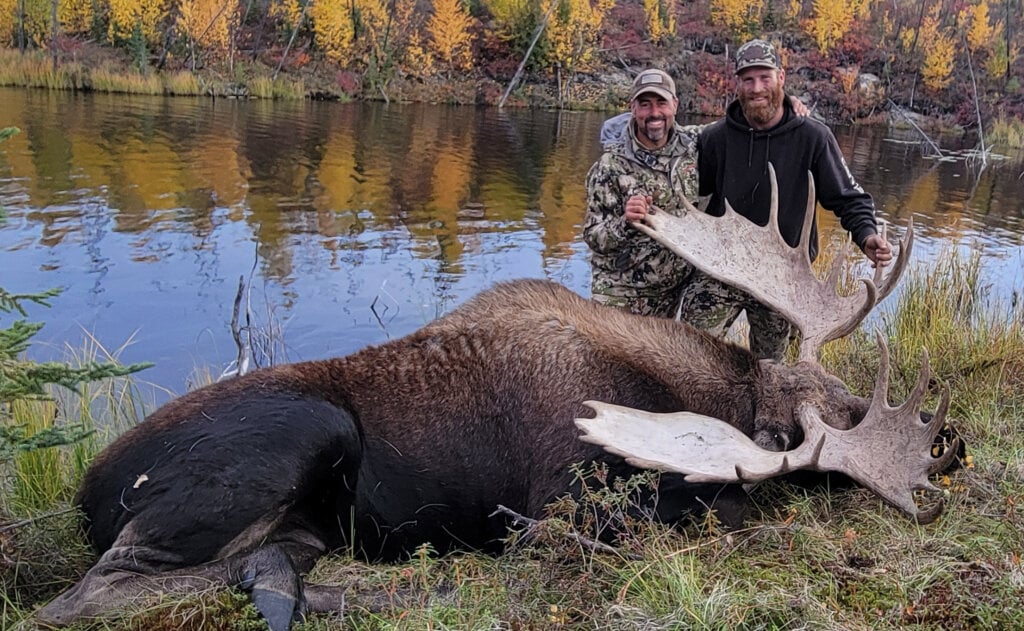
We hiked around the lake. On a small strip of land about 30 yards from shore, we found Hubert. From our angle, we hadn’t realized he was standing on an island. It didn’t matter—we were thrilled.
Boots off, socks off, down to our skivvies, we waded across. Water mid-thigh. Cold. We’ll leave it at that.
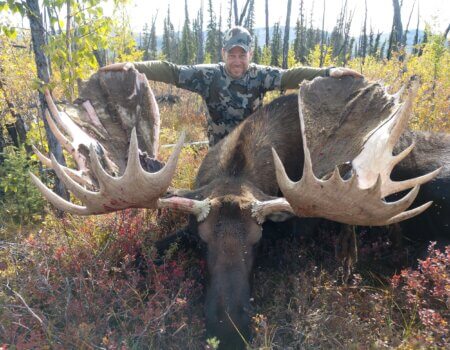
Up close, the bull was massive. His hoof dwarfed my hand. He officially spanned 58 ¾” (and yes, I round up to 59″).
After capturing the moment with plenty of photos, it was time to get to work. We realized we’d be spending the night on that island. It would be cold—down into the 30s. We had to cross back to the mainland for firewood, float logs across, and make do.
Hubert tipped over on land but was only inches from the water, making it challenging work. Derek promptly unfolded his turbo switchblade and went to work with Colston. I assisted where I could without getting in the way, but it was a big chore. Fast-forward to 3:30 a.m., and we were beat. We layered up and positioned ourselves as close to the fire as possible for the night. Sleep was minimal—every splash had me clutching my rifle, imagining bears.
We finished breaking down the moose the next morning and Derek called the pilot. Conditions were good and we soon heard the buzzing of the plane. The pilot took a shot at landing and nailed it. Three flights later, all of us and the moose were safely back at base camp.
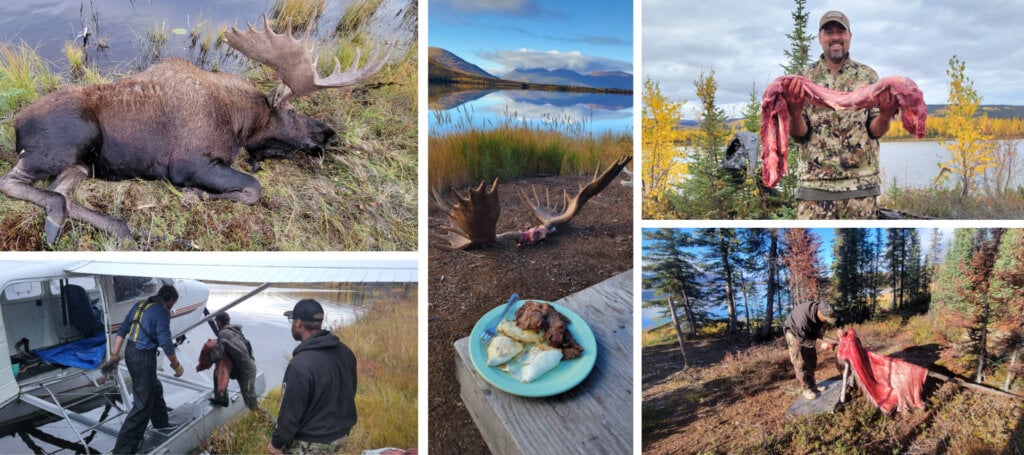
It was only Day 4 of a 7-day hunt, so I got to relax, fish a little, and soak in the silence. No phone. No TV. I even picked up a book again.
They picked me up on Day 6. Leaving the Yukon was bittersweet, but I was ready to get home and tell the story. And now, I relive it every time I walk into my house.
I learned a lot—not just about hunting, but about life. We all have barriers—time, money, self-doubt. But if you can muster the courage and find the means…do it.
To WTA, Yukon Peak Outfitters, and my supportive wife, thank you for making this dream come true.