Originally published in Hunter’s Horn magazine, Summer 2023.
The sitatunga is one of the most unique animals in the world, and a very specialized hunt is required for these elusive antelope.
The sitatunga is a medium-sized, spiral-horned antelope that mainly inhabits marshes and swamps throughout Africa. There are 3 subspecies: the southern sitatunga that inhabits the swamps of southern Africa in Zambia and Botswana, the forest sitatunga found in west and central Africa in Cameroon, Congo, etc., and the East African or Nile sitatunga in the Nile watershed of Uganda, South Sudan, etc.
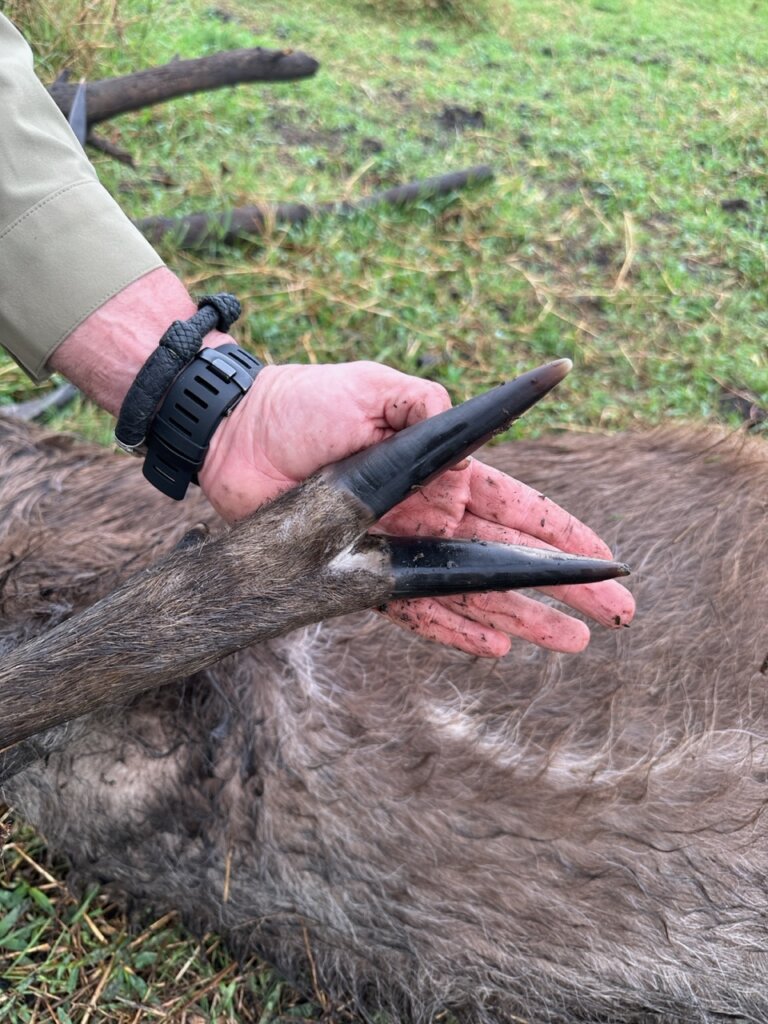
The East African sitatunga generally lives in large papyrus swamps where it spends its time on the reed mat that floats all over the swamp. There are small islands as well, but the sitatunga has evolved to have very elongated hooves that spread its weight (which can be up to 275 pounds) on the reed mats and help it walk on top of the floating vegetation. Of course, they also wade and swim in their very watery environment.
The challenge to hunting sitatunga is being able to see them at all. Their swamp habitat consists of tall papyrus and reeds from 6–12 feet tall covering the entire area outside of channels and small isolated islands. Sitatunga can walk anywhere in this dense vegetation and they have trails and tunnels throughout. They simply live and exist where we cannot follow.
This being the case, the common practice for hunting sitatunga is to utilize machans, or homemade shooting platforms, that elevate the hunter for better visibility in areas that are more clear. I recently returned from a hunt in Uganda for East African sitatunga with an outfitter that is phenomenally successful. They put a ton of effort into preparing their hunt areas and scouting, and it pays off with incredible success.
Not only do they have dozens of machans, but they also make “sitatunga plots” by each machan. What I mean by this is they chop the papyrus down to just a few inches high in plots that are generally 200–250 yards long and 75 yards wide. Chopping the papyrus stimulates growth of new shoots, and the sitatunga love to eat this tender new growth. Obviously, visibility is much improved where the almost impenetrable papyrus has been cut. Each machan overlooks 2–3 plots, and it is a huge amount of labor to keep these plots in shape.
Scouting is also key to success. The outfitter has 8–12 staff sitting in different machans during mornings and evenings watching to see which plots are being frequented by sitatunga. Trail cameras won’t do much good in these situations, so human eyes are the best scouting tools.
When John Trull and I got to sitatunga camp in the Kafu River basin of Uganda, the sitatunga movement had been slow due to a full moon but was picking up a bit as the new moon approached. We planned our hunt around the dark moon phase, so we were excited to hear that the action was getting better daily.
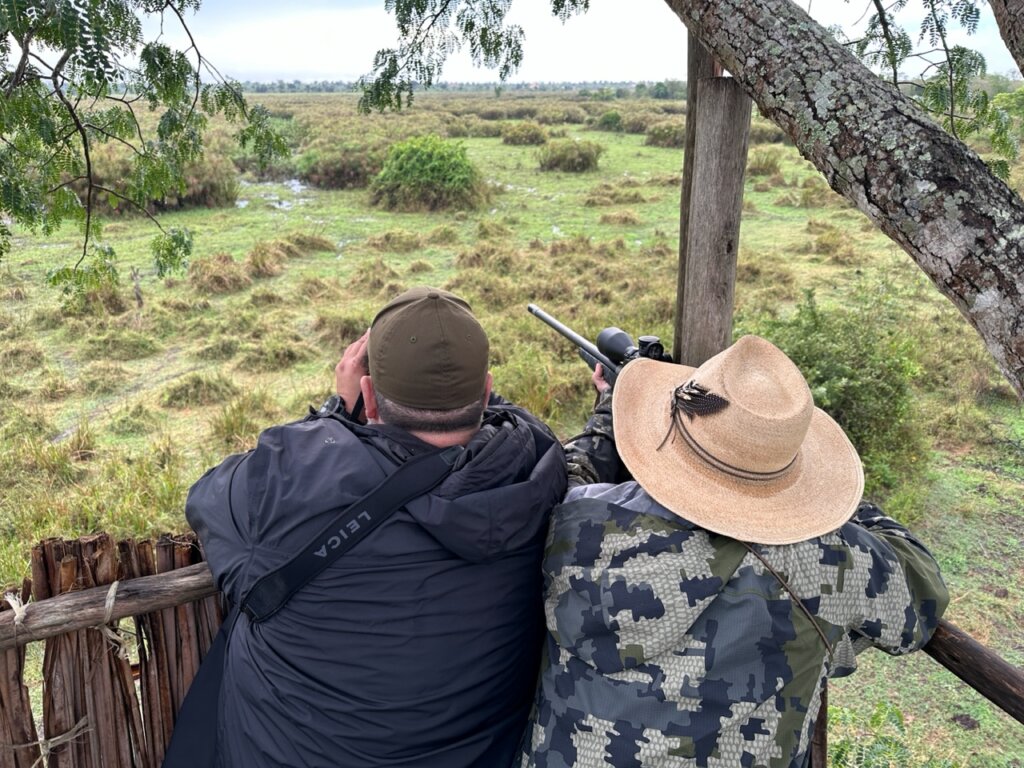
The first afternoon I went out, I saw a female and baby, but no males. The next morning, we decided to go across the big swamp to the machans on the far side where some of the scouts had been seeing bulls off and on. My first couple of hunts on that side did not produce any sightings at all. It seemed that whichever machan we chose did not produce, while bulls would be seen by scouts in other locations.
On the afternoon of our third day, we were in a machan and an hour or so before dark, a small bull emerged and fed in front of us at just 60 yards. We were on high alert as a small bull with a big bull had been sighted there a few times. Thirty minutes later, a scout showed up at the base of our machan and told us that a big bull had been seen in a cut at the machan to the west about 600 yards away.
We grabbed our gear and hot-footed it to the other machan. I’ll admit that our progress was not fast because I had surgery on my knee two weeks before and I was in a large leg brace and using a walking stick. When we got to the other machan, the scout showed us where he had seen the bull and in which direction he was moving toward another of our plots, so we hoped he would emerge. It was not to be as darkness overtook the swamp and we had not gotten so much as a glimpse of the bull.
I talked to my old friend and PH, Charl Von Rooyen, that night and decided that we needed to stop hopping around to different machans, pick one that was having decent movement, and wait it out. John and his PH, Christian Weth, had been doing the same, and it seemed that every time we switched machans, a bull would show up where we sat last.
The next morning, we crossed the swamp in a dugout canoe well before daylight, hoping to not be capsized by hippos, and made our way to the same machans we had gotten to the evening before where the bull had been seen. We decided we would sit in that hide until we found a good bull or time on our hunt ran out.
There was a heavy fog enveloping the swamp that morning. Just after dawn, I saw movement in the papyrus. It took some time for me to pick out the female sitatunga feeding at 125 yards as she was in and out of taller reeds and just occasionally in an opening. I watched her for about 45 minutes, and then she disappeared into the wall of tall papyrus.
About 30 minutes later, I was starting to daydream about having breakfast on our return to camp when Charl grabbed my arm and excitedly said, “Get your gun and get ready, there is our bull!” I asked where, and he told me to look in the same area where the female had been. When I raised my binos, I immediately saw wet, shiny horns. I grabbed my rifle.
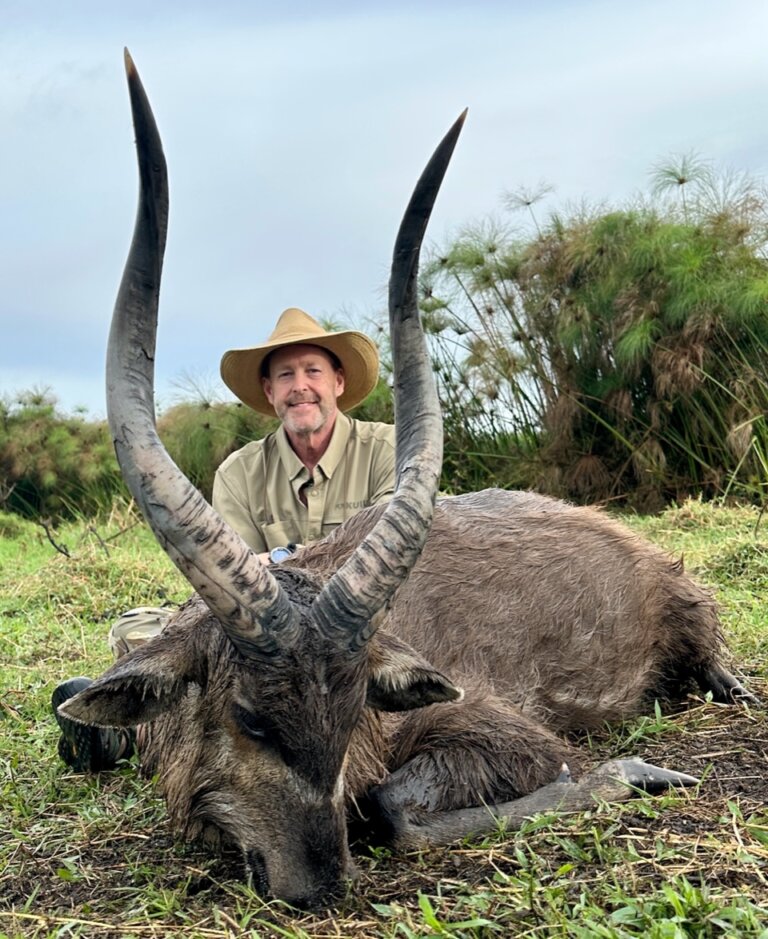
I cranked my scope up to 16-power, and when I quickly found the bull, it was a sight that will be burned into my memory forever. The big bull was quartering toward me, his head up, and his wet, polished horns glistening. I could see that he had very good mass, nice ivory tips, and the flaring shape that I had hoped for. As he took a step forward, I trained the crosshair on his shoulder and squeezed. My bullet found its mark and dropped him on the spot. Things happened really fast, but the image of the bull standing there on that misty morning is as clear to me as anything.
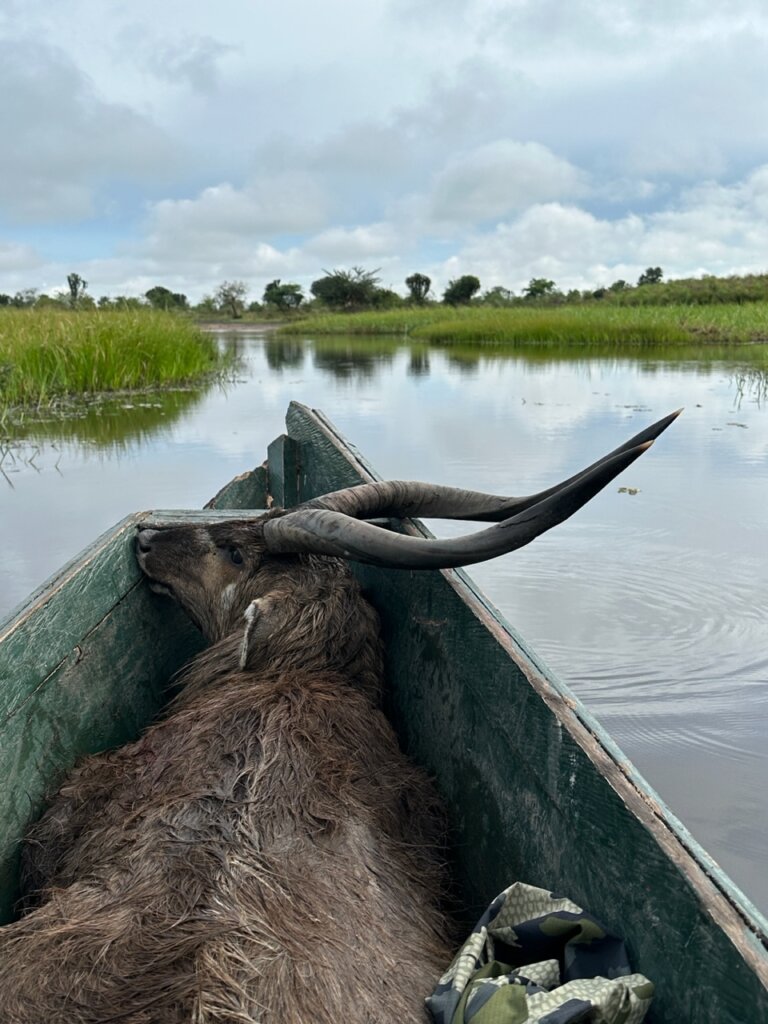
With my leg brace, I couldn’t attempt to go out into the swamp and recover him, but when our trackers recovered him for us, I couldn’t have been more pleased. He was a super old bull whose horns were polished almost white from years of walking through the tall papyrus. He had a beautiful lyre shape and was truly the bull of my dreams. The ride back across the swamp with the big bull in the front of the canoe was another life memory. Sitting there as we glided silently through the swamp and appreciating the time spent in such a wild place pursuing such a special animal was almost as good as the hunt itself.
That afternoon, Christian and John went to a machan where a bull had been sighted about every other sit. They decided to sit there for the next four hunt sessions and wait the bull out. It didn’t take long. At 4 p.m., two hours before most sitatunga move, a huge bull stepped into an opening a mere 90 yards in front of them feeding on papyrus and completely relaxed.
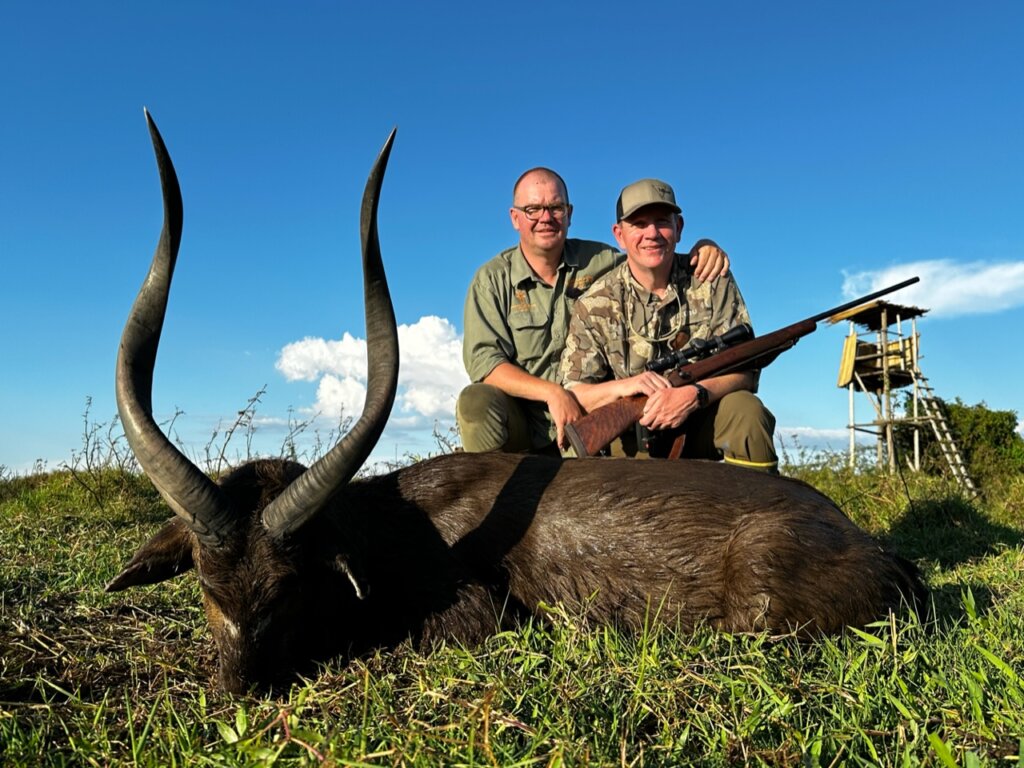
John made a good shot and dropped his bull. We had two wonderful sitatunga in the salt in one day. John’s bull was 28.5″ long. Comparing that to a B&C whitetail, it would equate as a 180″ buck, to give some reference. He was an incredible bull with the same beautiful shape as mine, just longer. We were two happy hunters!
Sitatunga hunting is specialized and probably not for the first-time African hunter, but they are gorgeous and unique animals, worthy of the time and effort it takes to hunt them. John and I were successful hunters number 48 and 49 in a row at Christian and Charl’s sitatunga camp, and a few days later they hit 50 in a row, which is quite a feat. A great area, a quality outfitter, and a lot of preparation are keys to success on the ghost of the papyrus. WTA has never had a client go there and NOT take a mature bull.