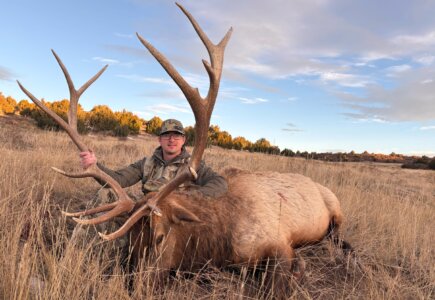
New Mexico’s draw system is a 100% random lottery, which means you could draw the tag of a lifetime your first year in, or you could wait a decade. You either get lucky or you don’t. I’ve been applying in New Mexico for years, and honestly, this wasn’t the year I expected to get the call. I’d hoped to draw a Montana archery elk tag, so I applied for one of New Mexico’s most coveted rifle elk units, fully expecting to come up empty. But instead, I drew the New Mexico tag and didn’t draw in Montana. That’s how it goes sometimes, and I wouldn’t trade the way it played out for anything.
The unit I drew is a rare place with both the genetics and the age structure to produce truly exceptional bulls. But it’s not a high-volume elk area. You don’t see elk on every hillside. You go with the understanding that you might only lay eyes on a handful of animals, but they could be the bull of a lifetime. That tradeoff is something every hunter needs to consider before applying. Are you willing to grind it out for a chance at something special, taking the risk that it might be a boring hunt? For me, the answer was simple.
The Outfitter Made the Difference
When I drew this tag, I didn’t need to scramble to find an outfitter. WTA already had a relationship with a guide who routinely operates in this unit. Despite the extremely limited number of tags issued each year, this outfitter spends time in the area every season. That kind of consistency is invaluable. He sees the trends year after year. He knows where the bulls tend to hang out during the rut, where they go after it winds down, and how they move through the country as conditions change. That accumulated knowledge gave us a significant head start.
In fact, our outfitter had been in the unit the week prior with one of our clients on the second archery hunt, so he already had fresh intel on where two big bulls had been hanging out. That’s a huge advantage you can’t replicate on your own.
Getting There and Setting Up: A Day and a Half of Silence
I live in Colorado, so I drove down to New Mexico, stopping to pick up the cameraman in Roswell. Once you leave pavement, you’re looking at an hour and a half to two hours on dirt roads to reach camp. We set up a standard wall tent camp and began scouting.
The canyon where the two big bulls were the week before is thick with trees and tight, offering no way to glass it without hiking in and risking bumping the elk out if they hadn’t moved. We elected to focus our scouting on the areas where the bulls would be likely to move into if they left their home canyon. That evening, we saw a couple of small bulls and a few cows. It was fairly uneventful. The following showed similar results, producing only a couple of smaller bulls, one 300″ type bull, and a handful of cows. A day and a half behind the glasses produced nothing of interest, but allowed us to narrow down the spots where the bulls we hoped to relocate had gone. That evening left me hoping the two bulls were sticking close to their canyon and we’d find them in the morning.
Finding the Bull
The next morning, we hiked into the canyon in the dark. At our first glassing point, nothing. We walked another 10 minutes to a second spot and set up tripods. The guide, Sam, turned up some elk on a face about 1,800 yards out. The longer we sat, the more elk started appearing. Cows, a few smaller bulls, and then a decent bull, probably around 330″, working the cows. Sam didn’t recognize him from the week before. He definitely wasn’t one of the bulls that had been with the herd during archery season.
I didn’t have any interest in shooting him. I’d taken a bull that looked just like him in the past, and I knew this unit could produce something better. Then Sam told me to look left. I swung the glass over and saw another bull in the brush, off by himself with just one small satellite bull. Even through the trees, you could tell he was substantially larger. Bigger frame, bigger body. This was the one I was looking for.
We sat and watched for probably two hours as the elk intermittently popped in and out of the brush. The herd of cows and the 330 bull eventually moved down and to our right. Meanwhile, I stayed glued to the big bull the entire time. If I took my eyes off him for even a moment, I’d lose him between the trees. I watched him walk into a thick patch of brush and not come out. After about 45 minutes, based on the time of day and the fact that he hadn’t emerged, we were confident he’d bedded down in that thicket.
The Long Wait
We threw on our packs and hauled down the canyon to get to the next hilltop, which put us roughly 650 yards from where the bull had been. We got set up with tripods and started glassing. At first, we couldn’t find him. Sam walked down the ridge for a better angle and eventually came back. He’d spotted a piece of the bull’s antler through the thicket and watched him move his head, confirming he was bedded right where we thought.
I set up my rifle on a bipod, built a solid rest, and got comfortable. Then we waited. And waited. We sat for at least two hours, watching that thicket. The bull got up once and rebedded in the same spot. We could see enough of his body through the brush to tell what he was doing. But I never had enough space for a clean shot. So we kept waiting.
He finally stood up, and for a moment it seemed like I might get my chance. But he turned and took a line through the thick stuff where I never had an ethical shot. I followed him with the rifle as he moved uphill, but I didn’t shoot. He disappeared into heavier cover and headed over the backside.
Cutting Him Off
Sam, knowing the country as well as he did, told us there was a dirt water tank on the backside of the hill at the mouth of the canyon. That’s likely where the bull was headed. We packed up fast and hauled down one hill and up the next, trying to cut him off. When we reached the opening on the far side, Sam edged out and found him immediately, working along the sidehill in the general direction he’d predicted.
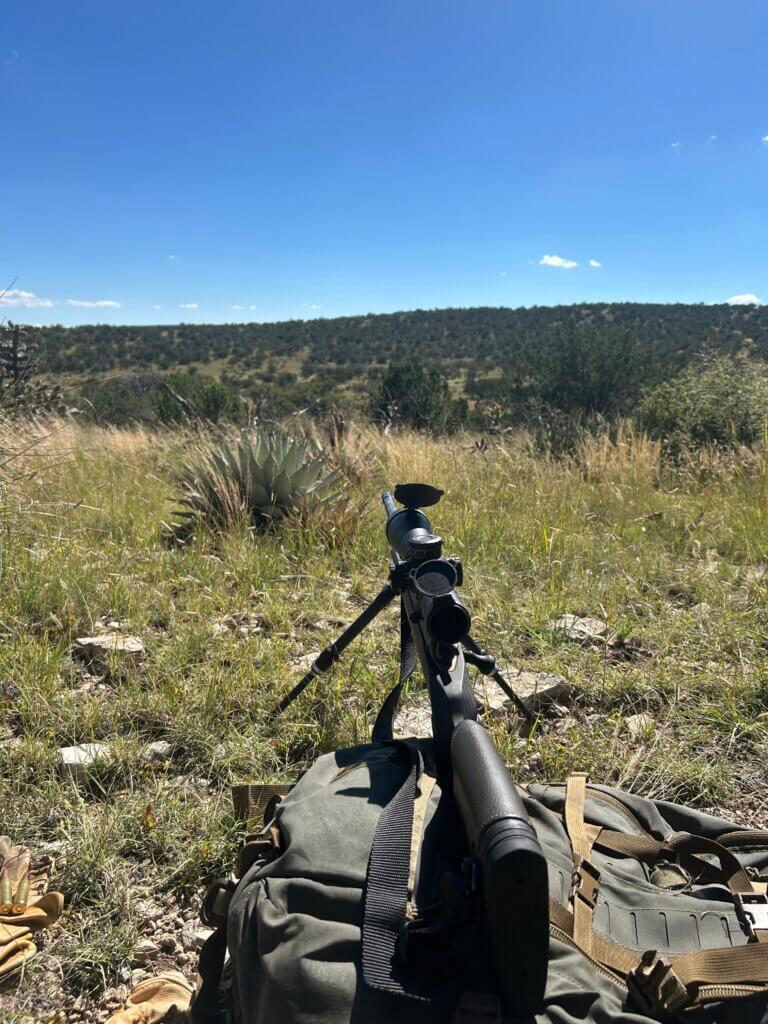
We all slid into position. I put my rifle up on the tripod, locked it in on the ARCA rail, and got multiple reliable range readings for doping. The bull was still moving, so rather than chase him with the crosshairs, I moved the rifle ahead to a clearing and waited for him to walk into it.
The Shot
He stepped into the opening at just over 500 yards. No wind. I had my data confirmed and was already settled in. When Sam gave the go-ahead, I sent the first round. It hit him hard and dumped his back end. I loaded up again immediately. When they’re still on their feet, you keep shooting. Precise shot placement goes out the window at that point and it’s about putting lead into them to bring them down. The second shot caught him in the neck and folded him like a suitcase.
Although a shot at just over 500 yards might sound like a long poke, it felt routine to me. Years ago, I attended Gunwerks Long Range University, where I discovered I was doing everything wrong—and I mean everything. They taught me everything from how to properly position the rifle to my body to the proper way to read and adjust for wind, elevation, and angle compensation. If you’re anything like me, a trip to an accredited shooting school will be beneficial, not only for you, but it will also allow you to pass this knowledge on to your kids and grandkids.
Ground Growth
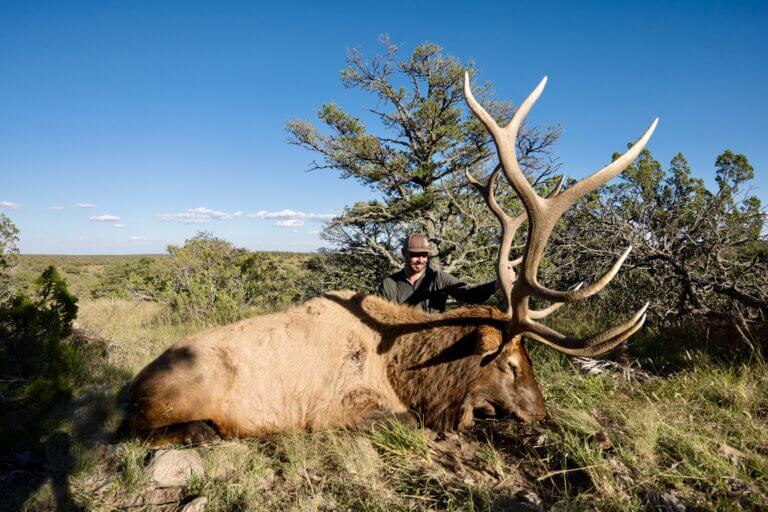
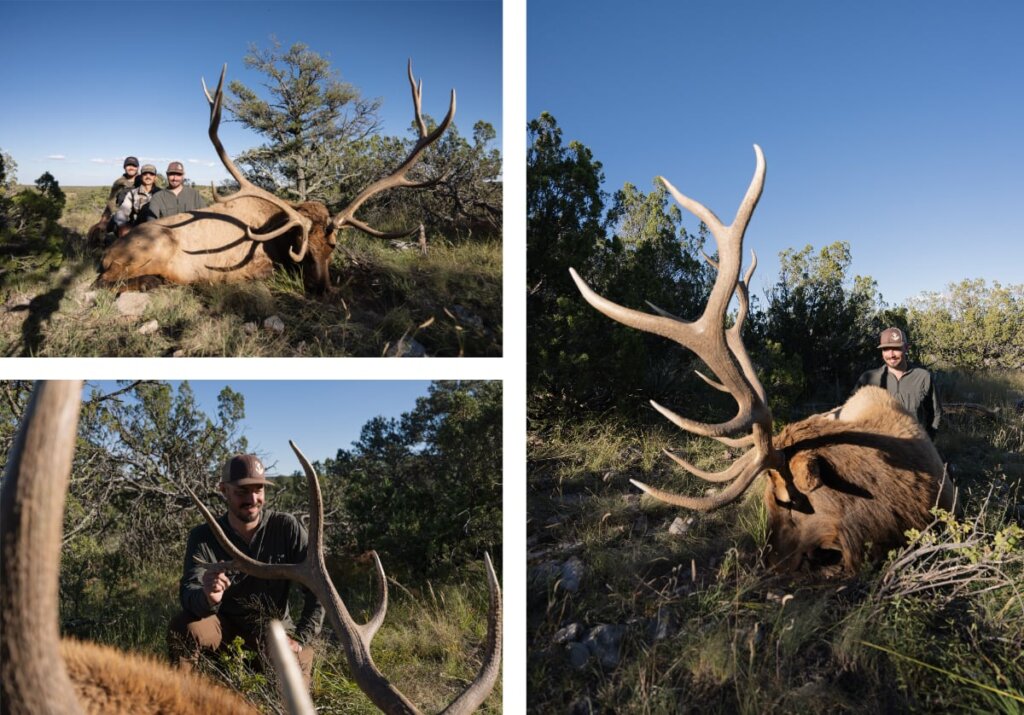
We sat for a few minutes to make sure it was over, then packed up for the walk over. When we got there, it became a moment every elk hunter dreams about. We knew he was a big bull, but the circumstances never allowed us to fully evaluate him before the shot. He was always in the brush, always partially obscured. You just knew he was a one-percenter, making him the type of bull you don’t pass up.
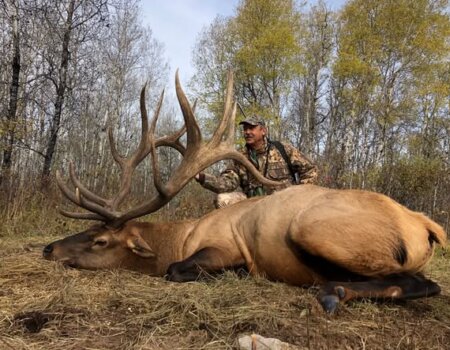
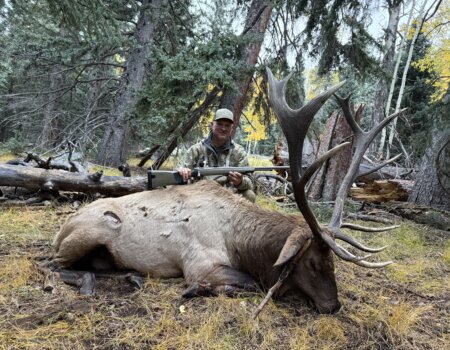
He grew substantially when we walked up to him. A lot of that was factoring in his body size. He was a big-bodied, old, mature bull. His main beams measured an uncommon 49″ and he was 54″ wide. His tines were incredibly long in a unique configuration. He grossed right around 378″, but a broken brow tine brought the green score to 356. Either way, this was a bull that exhibited ground growth, not ground shrinkage. The sheer size and age of him became more impressive up close.
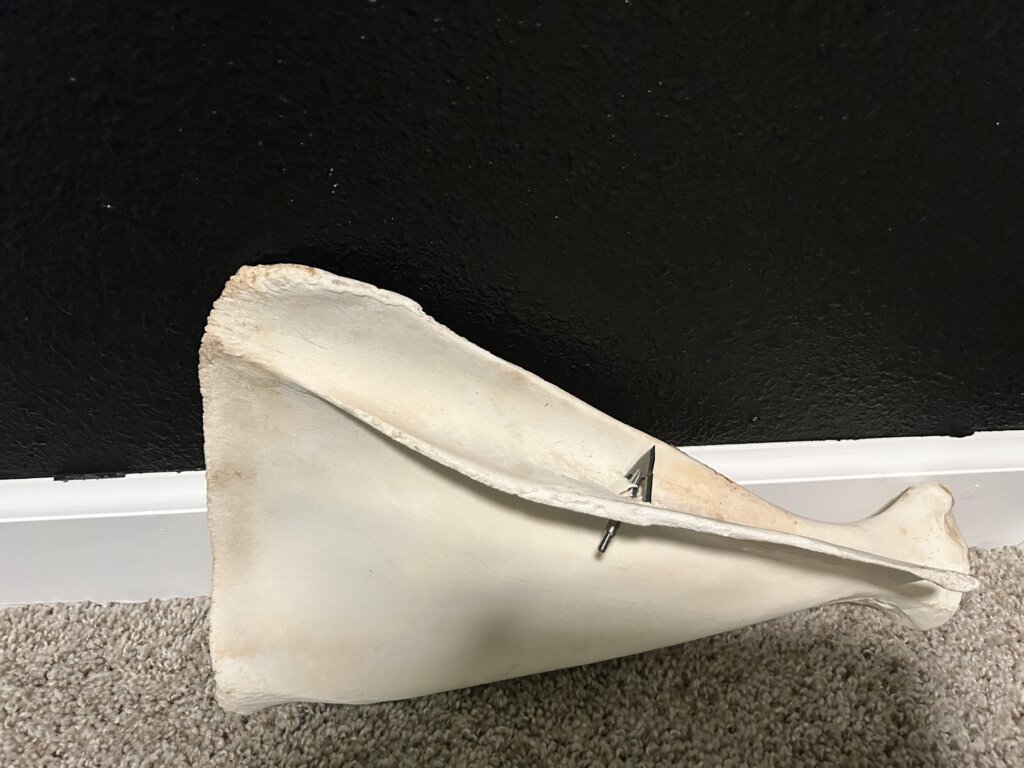
When we went to debone him later, we found a broadhead buried in his scapula with no sign of infection. The arrow shaft had broken off, leaving just the head embedded in the bone. Sam’s archery client had left early from the second hunt the week before for a business emergency, and during that gap, someone had apparently taken a shot at this bull. It was a small reminder of how tough these animals are and how many close calls they survive over the years.
A Bull Worth Waiting For
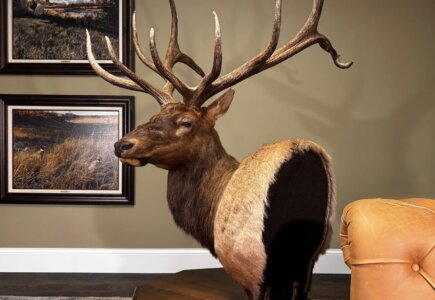
My house simply doesn’t have the ceiling height or floor space required for such a large animal, so he’ll be displayed at the WTA office until I’m ready to build a proper trophy room.
This bull represents my personal best, and a day I won’t forget anytime soon. From the moment we spotted him to the moment the shot broke, we spent between seven and eight hours on that bull. It was an all-day affair of glassing, waiting, repositioning, waiting some more, and then executing when the window finally opened. That’s the euphoria of big bull hunting. A lot of boredom punctuated by brief moments of sheer excitement.
I can’t say enough about the value of having the right outfitter on a hunt like this. His knowledge of the country, his ability to predict where the bull was heading, and his patience to let the situation develop were the difference between filling this tag and going home empty-handed. Through WTA TAGS, we work with outfitters who specialize in these specific units and know them intimately. When you draw a once-in-a-lifetime tag, that expertise puts you in a position to make the most of it.
If you’re not currently applying for limited-entry elk tags in New Mexico and other western states, you’re leaving opportunity on the table. New Mexico’s 100% random draw means you could pull a tag like this in your first year. But you can’t draw if you don’t apply.
Give TAGS a call at 1-800-755-8247 and let one of our consultants create a strategy that fits your goals. These tags are worth the wait, and when your number comes up, you want to be ready.